

Bengali Barbie Baby Tee
$40.00
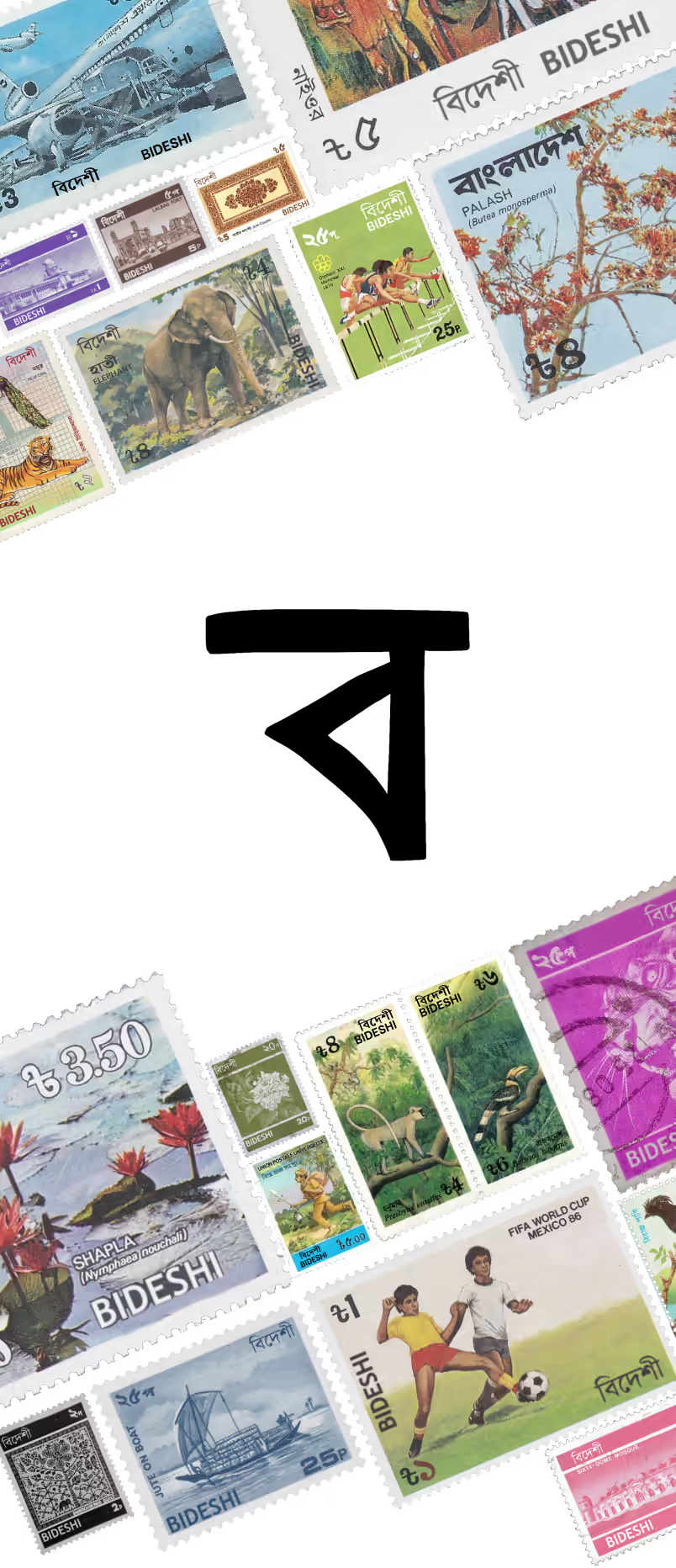
/bee-desh-ee/ adjective / noun
"foreign", referring to something or someone from another country or place
Baby Tee
Baby TeeShop NowFolk Tee
Folk TeeShop NowBy Myesha Munro · Culture · March 5, 2026
Photo: Bideshi Archive
Origins and Mythology of Bonbibi Bonbibi, also known as Bonodebi or Ma Bonbibi, is a forest goddess venerated across the Sundarbans by both Hindus and Muslims. Her story is primarily told in the Jahuranama, which blends Islamic and Bengali folk motifs, featuring Islamic characters such as Fatima and Muhammad, alongside Bengali names like Phulbibi. The Jahuranama is written in a mixture of Arabic, Persian and Bengali, and although it is written in the Bengali Hindu meter payar chhanda, it reads from back to front as with Arabic texts.[1] According to the Jahuranama, Berahim Fakir lived in Mecca and was married to a woman named Phulbibi who could not conceive a child. After consulting with his daughter Fatima, the prophet revealed that Berahim would have two children if he took a second wife. Phulbibi agreed to her husband taking a second wife on the condition that Berahim eventually fulfil a promise to her. When Berahim’s second wife, Golabibi, became pregnant, Phulbibi grew jealous and used her promise to banish Golabibi into the forest, where she gave birth to Bonbibi and Shah Jangali. Unable to care for both children, Golabibi abandoned Bonbibi to be raised by deer, establishing…
By Lutfun Nahar Tithi · Culture
Nature is full of wonders. There are certain magical days, when the world glows under a bright golden sun and without any warning, raindrops begin to fall through the sunlight. This rare meeting of sun and rain creates an ephemeral, enchanting wonder of nature known as the sunshower. A faint rainbow may bloom across the horizon, as if nature is smiling in secret. For any Bangladeshi, this sight br…
By Myesha Munro · Culture
What does ‘Brick Lane’ refer to? Brick Lane is a street in the East London borough of Tower Hamlets, which runs from Bethnal Green to Whitechapel High Street. The southern half of the street was formally recognised as London’s ‘Banglatown’ in 1997, and Brick Lane’s reputation as home to, and a cultural centre for, Bangladeshi people is so widely recognised that the electoral ward of Spitalfields w…
By Amar Lekh · Culture
Introduction Mary Kom, more aptly described as "Magnificent Mary," stands as an indomitable icon in the world of sports. Hailing from rural Manipur, her story is one of transcending poverty, societal barriers, and personal hardships to become the most successful female boxer in world championship history. As the only woman to win the World Amateur Boxing Championship six times and the only boxer t…
By Fariha Rahman · Culture · March 6, 2026
Photo: Bideshi Archive
Bengali Harlem: Migration, Memory, and the Making of a Diaspora NBC News (2019), photo courtesy of the family of Ibrahim Chowdhury highlighting a 1952 banquet, including mostly former ship workers from Bangladesh with their interracial families. In the early 20th century, before New York became home to one of the largest Bengali diasporas in the United States, small communities of South Asian sailors, peddlers, and workers quietly carved out spaces for themselves in the city. Among them were Bengali Muslims—many from present-day Bangladesh and West Bengal—who formed some of the earliest South Asian enclaves in Harlem and the Lower East Side.[1][2] Their story, largely unknown until recently, reveals a complex tale of migration, survival, and cultural blending that continues to shape the Bengali American identity today. Early Arrivals: Lascars and Peddlers in New York The first significant wave of Bengalis in the United States came not as a result of mass immigration, but through lascars—South Asian sailors employed on British merchant ships. Thousands of lascars passed through American ports between the late 1800s and early 1900s.[1] Some jumped ship or overstayed, seeking better o…
By Zannatul Isaque · Culture
Apu from the Simpsons is technically Bengali-Hindu, but his portrayal as a homogenized Indian is at odds with his origins. As a result he repeats, enables, and affirms the homogenized Indian stereotype, and the popularity of the character has let the homogenized Indian stereotype trickle down into other comedy series, even those aimed at children. This is about whether or not Apu is harmful, and n…
By Fariha Rahman · Culture
That Small Crunch you hear in the Streets of South Asia: Is it Fuchka, Pani Puri, or Golgappa? On the streets of South Asia, you will find people munching on a hollow puri that tastes sweet, savory, or even tangy, depending on the filling and flavored water in it. This universal street food is known by different names, such as fuchka, golgappa, or pani puri.[1] The variation in names comes from th…
By Angela (Anj) Saha · Culture
Acknowledgement Bangladesh is not secular. While the majority of the population follows Sunni Islamic practices, the country does pride itself on being a place for all to rejoice and celebrate their respective religion. Bangladesh currently consists of 80% Muslim, mainly Sunni, with a small number being Shia, 13% Hindu, and the rest being Buddhist or Christian. [1] Bangladesh has established Islam…
By Sarina Nushrat · Culture · March 6, 2026
Photo: Bideshi Archive
Introduction Long before a Bengali child learns to write their name, they learn something much more complicated: that they have more than one. This realization rarely arrives with ceremony. No one sits you down and explains it. It happens abruptly, usually at school, when a teacher calls out a name and you look around the room to see who is being addressed, only to realize, with some alarm, that it is you. Thus unfolds your lifelong lesson in living between identities. In a Bengali person's life, a name functions less as a single label and more as an entire system. It comes in pairs. One name is meant to be written down whereas the other name is meant to be spoken. One is built for history and the other is built for love. Bhalo Nam The bhalo nam (ভালো নাম), literally the 'good name', is the name that is cooperative with modern, everyday society. It is "for identification in the outside world" [3]. It submits politely to forms, databases, certificates, hospital wristbands, and eventually, if tradition has its way, your gravestone. It is the name that will outlive you, circulating long after the person it once referred to has left the world. This is the name institutions prefer and i…
By Ibraheem Syed · Culture
Marble, Myth, and Mughal Memory: The Enigma of Lalbagh Fort Attracting around 3 million visitors a year, in the heart of Old Dhaka lies one of Bangladesh's most iconic historic sites, Lalbagh Fort, or locally known as "Lalbagh Kella" meaning "Red Garden" [1][2]. However, as grand as it is, what remains of the fort is an unfinished construction, with mysteries and myths surrounding its sudden halt…
By Parizad Nizam · Culture
Every year, as winter loosens its brief grip on Bengal, the month of Falgun arrives in colour. Pohela Falgun (পহেলা ফাল্গুন), the first day of Falgun, marks the beginning of Boshonto (বসন্ত), spring, in the Bengali calendar, and is celebrated across Bangladesh with flowers, music, poetry, and a vivid palette of spring colours. Credits: Orchid Chakma, The Daily Star The Bengali Calendar Unlike the…
By Majidah Chowdury · Culture
Bangladesh produces nearly 3% of the global tea output, according to the Bangladesh Tea Board, consistently ranking amongst the top 10 global tea producers as of 2025 and exporting to numerous countries, such as Pakistan, the UAE, Russia and the United States.[1] The industry provides over 100,000 people with direct employment in 166 tea estates, providing livelihood to 500,000 people directly and…
By Danial Zakaria · Culture · March 6, 2026
Photo: Bideshi Archive
Bangladesh's participation in the world-famous Olympics align heavily with the nations it found itself part of across history. However, its history also tells a larger story on how structural disenfranchisement and oppression significantly affects a nation's performance in an industry we usually consider to be unifying and meritocratic; sport. Through looking at the effects of British colonisation and Pakistani oppression, and a lasting deficit on athletic talent that remains today, the reasons for why Bangladesh is the largest nation to have never won an Olympic medal remains all too evident. Their main participation within the Olympics has primarily been through the wildcard system, which grants athletes from nations typically underrepresented in specific sports to qualify without a traditional, strict qualification process. This article will take a look at a historical timeline of Bangladesh's participation in the Olympics, within different nations and as its own nations, as well as considering the socioeconomic factors developed over time which have limited the success Bangladesh has experienced across one of history's oldest, and most prestigious sporting events. British India…
By Nushaab Syed · History
On 1 August 1971, George Harrison of the Beatles played two shows at Madison Square Garden, one at 2:30 in the afternoon and one at 8:00 in the evening, to a combined audience of roughly 40,000 people [1]. The setlist included the likes of Ravi Shankar, Ali Akbar Khan, Alla Rakha, Kamala Chakravarty, Bob Dylan, Eric Clapton, Ringo Starr, Billy Preston, Leon Russell, Klaus Voormann, and Badfinger […
By Nushaab Syed · Info
Bangladesh is defined by its thousand-odd rivers, a network that has historically gifted the nation its most fertile soil. Yet, this lifeline is also a seasonal source of profound grief. The same waters that sustain the delta and its people have, once again, turned into a medium for destruction. In the past week, the seasonal monsoon returned with an intensity that defied all preparation, claiming…
By Lutfun Nahar Tithi · Culture
Khona is a name that has been echoing in Bengali households from generation to generation from ancient times, yet the identity of Khona remains an enduring enigma. Who Khona was and who wrote Khona’s Bochon still remains a mystery lost from the letters of history, but that has not suppressed her fame nor stopped the widespread recognition of her sayings. Khona Who Is Khona? Khona is a prominent an…
By Fariha Rahman · Culture · March 6, 2026
Photo: Bideshi Archive
Community
From our village
“Love this tee so much! I’ve honestly been searching forever for a shirt that says “Bangladesh” but still feels stylish and modern. Most of the ones I’ve come across were oversized in an unflattering way or just didn’t match today’s fashion trends. This one is exactly what I was looking for. The fit is perfect, flattering cut that you can easily dress up or down. It feels comfortable without looking sloppy, and the quality is great too. I love that I can represent Bangladesh in a way that feels authentic to me and still fits seamlessly into my everyday wardrobe. Definitely a staple piece and one I’ll be wearing on repeat!”
bangladesh baby tee
Soyma Ahmed
Deltona, Florida, United States
“Love this tee so much! I’ve honestly been searching forever for a shirt that says “Bangladesh” but still feels stylish and modern. Most of the ones I’ve come across were oversized in an unflattering way or just didn’t match today’s fashion trends. This one is exactly what I was looking for. The fit is perfect, flattering cut that you can easily dress up or down. It feels comfortable without looking sloppy, and the quality is great too. I love that I can represent Bangladesh in a way that feels authentic to me and still fits seamlessly into my everyday wardrobe. Definitely a staple piece and one I’ll be wearing on repeat!”
bangladesh baby tee
Soyma Ahmed
Deltona, Florida, United States
“Great quality and super comfy”
bangladesh baby tee
Shakh Foizia
“First, the shipping was fast and easy. Second, the shirt is amazing. Finally, there’s some awesome Bangladeshi merch we can wear!””
bideshi folk tee
Rafat Islam
New York, New York, United States