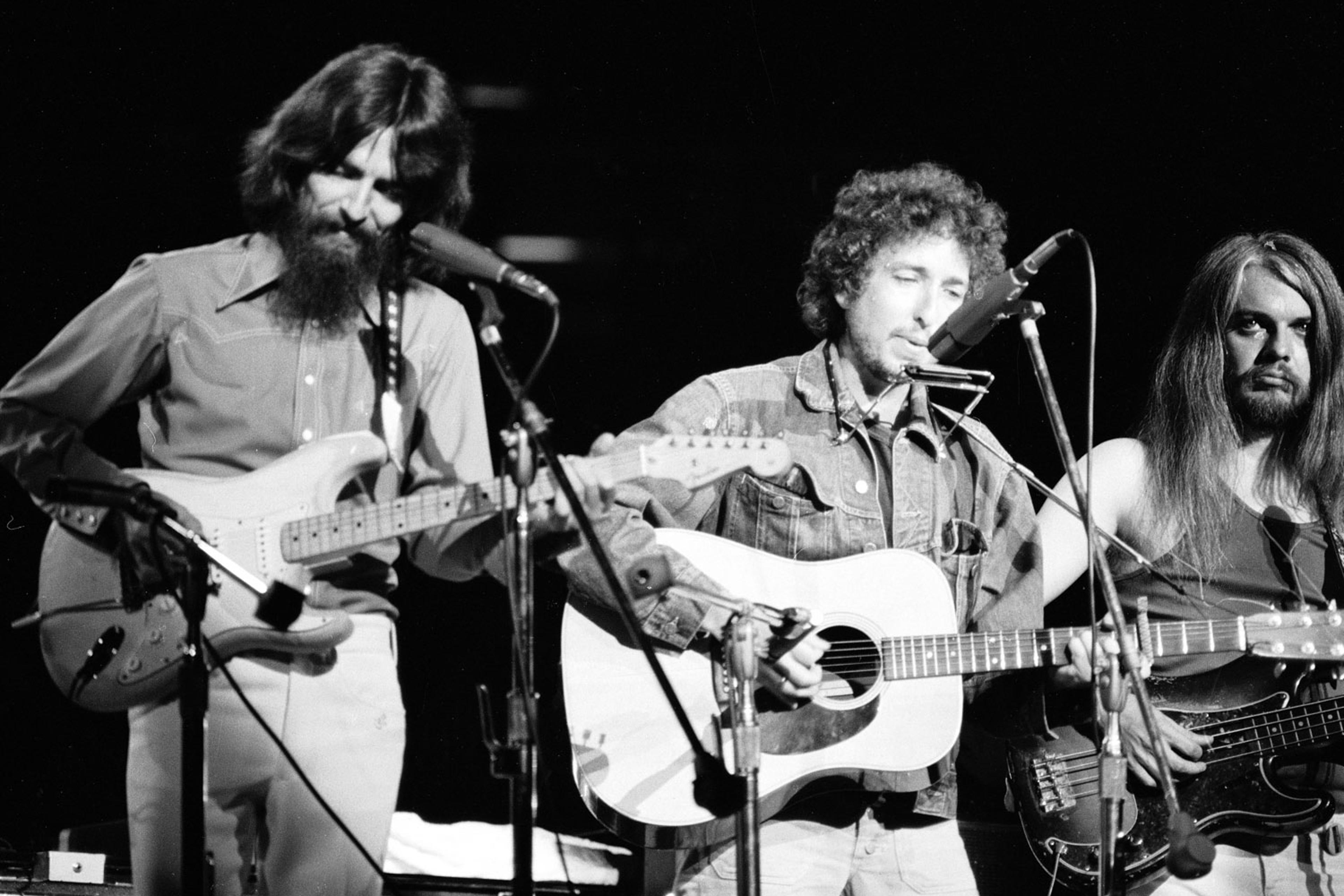
On 1 August 1971, George Harrison of the Beatles played two shows at Madison Square Garden, one at 2:30 in the afternoon and one at 8:00 in the evening, to a combined audience of roughly 40,000 people [1]. The setlist included the likes of Ravi Shankar, Ali Akbar Khan, Alla Rakha, Kamala Chakravarty, Bob Dylan, Eric Clapton, Ringo Starr, Billy Preston, Leon Russell, Klaus Voormann, and Badfinger [1], [2]. The proceeds went to UNICEF for refugees from East Pakistan (modern-day Bangladesh).
The concert is credited to be the origin of the celebrity benefit, the same formula Live Aid eventually copied. But what’s interesting is why it was George Harrison who headlined, why an American audience was willing to sit through forty minutes of Hindustani classical music before the rock started, and why it took nearly a decade for the funds to finally reach the hands of Bangladeshis.
George Harrison meets Ravi Shankar
In 1965, George Harrison heard Indian instruments on a film set. As a guitarist, he was intrigued by the sound of the sitar, and bought a cheap one from a shop called Indiacraft on Oxford Street. This eventually led to him playing it on "Norwegian Wood (This Bird Has Flown)" that October, making it the first Western pop record to feature the instrument prominently [3]. What followed was a new wave in the music coming out of the UK. The Kinks and the Yardbirds had already started infusing South Asian sounds in their music that same year, the Rolling Stones put sitar on "Paint It, Black," and people started coining the term "raga rock" to describe this phenomenon [4].
George Harrison’s connections to Hindustani classical music grew deeper when he was introduced to the sitar virtuoso Ravi Shankar on 1 June 1966 [5]. That fall, Harrison travelled to India and studied with him for six weeks, part of it on a houseboat in Kashmir [7]. He effectively put down the guitar for close to two years [8].
Ravi Shankar had reasons to be wary of the audience that fandom had built. He played Woodstock in 1969, the last rock festival he agreed to do [9]. He said he was hurt that his tradition was being treated as a passing fad, that listeners arrived intoxicated and inattentive, and that he sometimes picked up his sitar and walked off rather than continue [10]. The Concert for Bangladesh would give him a large Western audience again, this time on terms he had helped set.
The crisis, and what Washington was doing about it
In November 1970 the Bhola cyclone struck the Ganges delta, with East Pakistan bearing the brunt of the disaster. It remains the deadliest tropical cyclone on record, with estimates between 300,000 and 500,000 dead [12]. The Pakistani government's slow response fed directly into the December 1970 election, in which Sheikh Mujib’s Awami League swept elections in East Pakistan, securing the government of the nation [13]. When West Pakistan refused to hand over rule to the Awami Leagure, the army launched Operation Searchlight in March 1971. By UNHCR's count, some ten million people crossed into India over the following months, one of the largest single refugee movements of the twentieth century [14].
The United States knew. Archer Blood, the American consul general in Dhaka, and twenty of his staff sent a dissent cable in April 1971 stating that their government had failed to denounce the atrocities by the Pakistan Army [15]. President Nixon and Secretary of State Kissinger ignored it, because the Pakistani regime was providing the backchannel to Beijing that made Nixon’s 1972 visit to China possible [16]. Despite the atrocities, American arms kept flowing into the hands of the army. Coverage of East Pakistan’s struggle in the American press stayed thin.
Planning the concert in five weeks
Shankar, whose family had roots in the region, wanted to do something to help with the refugee crisis that had ensued, and initially aimed low. He hoped a benefit might raise around $25,000, and he approached Harrison because he understood that anything larger required a Beatle [17].
Harrison agreed and immediately scaled it up. The project began in earnest in the last week of June 1971. The only dates available at Madison Square Garden were the weekend of 31 July and 1 August, which left roughly five weeks to assemble everything [18]. Harrison recorded the single "Bangla Desh" in Los Angeles in early July and released it days before the shows, making it the first charity single in rock [18].
His first calls were to the other Beatles. Ringo Starr agreed at once and interrupted the filming of Blindman in Spain to attend [19]. John Lennon agreed on the condition, set by Harrison, that Yoko Ono would not perform. He then argued with Ono about that condition and left New York two days before the concerts [19], [20]. Paul McCartney declined outright, citing the state of the band's breakup litigation [20]. Eric Clapton said yes while in the grip of a heroin addiction and missed every rehearsal until the final soundcheck [21]. Dylan agreed but never firmly committed, and Harrison did not know for certain that he would appear until he saw him moving toward the stage [17].
What happened on stage, and after
Both shows opened with Indian classical music, and that was a structural decision rather than a courtesy. Shankar on sitar, Ali Akbar Khan on sarod, Alla Rakha on tabla, and Kamala Chakravarty on tanpura played a piece titled "Bangla Dhun" that ran about fifteen minutes [17]. Shankar and Khan both had ancestral roots in the region the concert was for.
Harrison then opened the rock portion with material from All Things Must Pass, including "Wah-Wah," "My Sweet Lord," and "Awaiting on You All" [17]. Billy Preston played "That's the Way God Planned It." Leon Russell took a medley. Harrison sang "Here Comes the Sun" with Badfinger's Pete Ham, and performed "Something" and "While My Guitar Gently Weeps" for the first time since the Beatles stopped touring. It was also the first time he and Starr had shared a stage since 1966 [21].
Bob Dylan's set was a surprise. He played five songs, among them "A Hard Rain's A-Gonna Fall," "Blowin' in the Wind," and "Just Like a Woman," backed by Harrison, Russell, and Starr [17]. It was his first major concert appearance in the United States in five years [21]. Harrison closed with "Bangla Desh." A three-record live album from the shows followed in December 1971. This had given Indian classical music its largest Western audience to that date [23].
The amount earned from selling tickets came to $243,418.50, transferred to UNICEF in August 1971 [19]. Because the project had been assembled in five weeks, it was never registered as a UNICEF benefit in advance, and so never received tax-exempt status [29]. Millions raised from the benefit sat in an Internal Revenue Service account [29]. It took a while, but by 1981 a further $8.8 million had been released, and by the mid-80s an estimated $12 million had reached Bangladesh relief [29]. The album won the Grammy for Album of the Year in March 1973 [30].

When Bob Geldof organised Live Aid in 1985, he went to Harrison specifically for guidance on how to keep the proceeds from getting trapped the same way [31]. Live Aid raised over $100 million and, unlike its predecessor, was able to get most of it to charity [32].
An outsized impact
Shankar's own idea of what this concert accomplished was not about the money raised. He said the whole world learned the name of Bangladesh in a single day [1]. The country was recognised by 86 states within a year [37].
Harrison later put the practical value of his efforts at two things: a morale boost for Bengalis, and attention drawn to what the Pakistani army was doing [28]. Fifty-five years later, we know the concert did not end the war, but it did help make the struggles of a people visible at the moment when the most powerful government in the world had a specific interest in keeping it invisible.
Sources
The Concert for Bangladesh. The Paul McCartney Project. https://www.the-paulmccartney-project.com/1971/08/the-concert-for-bangladesh/
"The Concert for Bangladesh." Wikipedia. https://en.wikipedia.org/wiki/The_Concert_for_Bangladesh
Abraham, Hannah. "Ravi Shankar In The Beatles Films." Forbes, 2026. https://www.forbes.com/sites/hannahabraham/2026/02/12/ravi-shankar-in-the-beatles-films-who-was-the-sitar-maestro-who-changed-george-harrison-forever/
"Raga Rock." Rate Your Music, summarising Bellman, Miller, and Schaffner on the subgenre's origins. https://rateyourmusic.com/genre/raga-rock/
"Asian Music Circle." Wikipedia. https://en.wikipedia.org/wiki/Asian_Music_Circle
Jackson, Blair. "On Ravi Shankar and the Dead." Dead.net. https://www.dead.net/features/blair-jackson/blair-s-golden-road-blog-ravi-shankar-and-dead
Covach, John. The Inner Light: The Beatles, India, Gurus, and the Legacy. University of Rochester, 2021. https://www.rochester.edu/advancement/wp-content/uploads/2021/06/The-Inner-Light-John-Covach-5.27.21.pdf
"How playing sitar helped George Harrison become a guitar legend." Guitar Player. https://www.guitarplayer.com/players/george-harrison-guitar-legend
"At the Woodstock Festival." Wikipedia. https://en.wikipedia.org/wiki/At_the_Woodstock_Festival
"Ravi Shankar: 50 Years of Peace & Music." Bethel Woods Center for the Arts. https://www.bethelwoodscenter.org/news/detail/ravi-shankar-50-years-of-peace-music
"Indian sitar virtuoso Ravi Shankar dies at 92." Associated Press, 2012.
"1970 Bhola cyclone." Wikipedia. https://en.wikipedia.org/wiki/1970_Bhola_cyclone
Mobarak, Ahmed Mushfiq. "The 1970 Bhola Cyclone and the Birth of Bangladesh." Salata Institute, Harvard University. https://salatainstitute.harvard.edu/
"UNHCR honoured by Bangladesh for helping millions in 1971 conflict." UNHCR. https://www.unhcr.org/us/news/stories/unhcr-honoured-bangladesh-helping-millions-1971-conflict
"The Genocide the U.S. Can't Remember, But Bangladesh Can't Forget." Smithsonian Magazine, 2016. https://www.smithsonianmag.com/history/genocide-us-cant-remember-bangladesh-cant-forget-180961490/
"The Blood Telegram: Nixon, Kissinger, and a Forgotten Genocide." Wikipedia. https://en.wikipedia.org/wiki/The_Blood_Telegram:_Nixon,_Kissinger,_and_a_Forgotten_Genocide
"How George Harrison Pulled Off 'The Concert For Bangladesh.'" uDiscover Music. https://www.udiscovermusic.com/behind-the-albums/george-harrison-the-concert-for-bangladesh/
"1 August 1971: Live: The Concert For Bangla Desh." The Beatles Bible. https://www.beatlesbible.com/1971/08/01/live-concert-for-bangla-desh/
"George Harrison's Crowning Moment: The Concert For Bangladesh." This Day in Music. https://www.thisdayinmusic.com/liner-notes/george-harrison-concert-for-bangladesh/
"The Concert for Bangladesh." Culture Wikia. https://culture.fandom.com/wiki/The_Concert_for_Bangladesh
"George Harrison and Friends." Last.fm artist wiki. https://www.last.fm/music/George+Harrison+And+Friends/+wiki
"The Concert for Bangladesh (film)." Wikipedia. https://en.wikipedia.org/wiki/The_Concert_for_Bangladesh_(film)
"The Concert for Bangladesh (album)." Wikipedia. https://en.wikipedia.org/wiki/The_Concert_for_Bangladesh_(album)
"The Who: Live At The Oval 1971." The Second Disc, 2025. https://theseconddisc.com/2025/05/08/the-who-live-at-the-oval-1971-farewell-tour/
"Live at the Oval 1971." Wikipedia. https://en.wikipedia.org/wiki/Live_at_the_Oval_1971
Bass, Gary J. The Blood Telegram: Nixon, Kissinger, and a Forgotten Genocide. Knopf, 2013.
"The Legacy of George Harrison's 'Concert for Bangladesh' Half a Century Later." PopMatters, 2022. https://www.popmatters.com/george-harrison-concert-bangladesh-atr50
"All the concert(s) for Bangladesh." Dhaka Tribune. https://www.dhakatribune.com/opinion/longform/194528/all-the-concert-s-for-bangladesh
"The most radical thing George Harrison did happened after he left the Beatles." Uncut. https://www.uncut.co.uk/features/the-most-radical-thing-george-harrison-did-happened-after-he-left-the-beatles-155638/
"The Concert For Bangladesh Wins Album Of The Year." GRAMMY.com. https://www.grammy.com/videos/15th-annual-grammy-awards-album-of-the-year
"Celebrating The 50th Anniversary Of The Concert For Bangladesh." NPR, 2021. https://www.npr.org/2021/07/30/1022352422/concert-for-bangladesh
"35 years after Live Aid, Bob Geldof assesses personal toll." Associated Press, 2020.
"Raga Rock." Melodigging. https://www.melodigging.com/genre/raga-rock
"Asian Underground." Melodigging. https://www.melodigging.com/genre/asian-underground
Joshi, Tara. "A potted history of the 1990s British (South) Asian Underground." Mixmag. https://mixmag.net/feature/south-asian-underground-1990s-history-series-ritu-nitin-sawhney-sweety-kapoor
"Talvin Singh." Wikipedia. https://en.wikipedia.org/wiki/Talvin_Singh
"The Concert for Bangladesh." Sunday Times, 1 August 2021. https://www.pressreader.com/south-africa/sunday-times-1107/20210801/282535841411479