


Who are the Rohingya
The Rohingya are a largely Muslim minority ethnic group who have been denied citizenship in Myanmar since 1982. In August 2017, more than 74,000 Rohingya were forced to flee their homes by armed attacks in Rakhine State.[1] The UN has described the Rohingya as ‘the most persecuted minority in the world’,[2] making up one-third of the world’s stateless population.[3]
The Rohingya trace their ancestry from ‘Moorish, Arab, and Persian traders, and Moghul, Turk, Pathan, and Bangalee soldiers and migrants’.[4] Their ancestral roots include the Arakan region, which is today understood to be the Rakhine state, but in its time as a pre-colonial independent kingdom, this region spanned down to present day Chittagong. Myanmar’s government reject the use of the word Rohingya, an ethnonym that infers their historic connection to the Rakhine region, instead referring to them as ‘Rakhine Muslims’ or ‘Bengali’.
55% of the Rohingya migrants in Bangladesh are children, with about 40,000 orphans crossing the border between 2017 and 2022. Large numbers of Rohingya have also fled to India, Indonesia, Malaysia, Pakistan, Saudi Arabia, and Thailand.
History of Rohingya mistreatment
During the British Colonial Period (1824 -1948), the Muslims living in Arakan preferred British rule to the ‘tyranny of the Burman army’.[5] Between 1942 and 1945, Japan invaded what was then British-controlled Burma, and the Muslims continued to support British occupation, while the Buddhists supported the Japanese. In 1948, Burma became an independent republic whose government passed the Union Citizenship Act. This act recognised all citizens, including minority groups such as the Rohingya, allowing them to vote and to serve as members of parliament.
A military coup in 1962 overthrew the elected government, allowing General Ne Win to take power for the following 26 years. It was under General Ne Win that the Emergency Immigration Act of 1974 was passed, decreeing that all citizens of Burma aged 15 years or over must carry a National Registration Certificate (NRC).
Brinham argues the state’s use of identity card schemes demonstrates ‘a historic trail of intent’ and the ‘existence of a coordinated plan to erase and destroy [the Rohingya] as a group’.[6] The various identity cards deployed by Myanmar’s government segregated the Rohingya from the Burmese community, singling them out for discrimination and persecution. The nationalistic ideologies developed and legitimised by the period of military rule that followed the 1962 coup were enforced through the use of such identity cards.
Myanmar’s 1982 Citizenship Act excluded the Rohingyas from the right to citizenship by refusing to recognise them among the country’s 135 official ethnic groups, therefore rendering them stateless. This was followed by waves of violence and concurrent waves of exodus, particularly in 1992, 2001, 2009, 2012, and 2017. Government officials would forcefully remove land without compensation, and respond to resistance with violence and threats of violence. Freedom of movement, access to education and access to healthcare were curbed, and the freedom to practice Islam was combated with the destruction of Mosques and appropriation of mosque lands.
In 1989, the government rolled out a colour-coded state ID in conjunction with the 1982 Citizenship law. This colour coding system isolated and othered the Rohingya community, whose cards were white to signal their undecided national status.[7] These ‘white cards’ marked out Rohingya as originating in the Northern Rakhine State, which could lead to internal ‘deportation’ from elsewhere in Myanmar to the North Rakhine State, where the government was increasingly containing the Rohingya population through the use of camps and military surveillance. The NaSaKa was established in the early 1990s and directed by the former head of military intelligence, General Khin Nyunt, a border security force established entirely to monitor and control the Rohingya population.[8] This was partly achieved through an informer network, destroying community trust and creating a fearful and paranoid environment.
In Myanmar’s 1990 general election, the Rohingya overwhelmingly favoured the National League for Democracy (NLD). Although the NLD won the election, the military junta refused to recognise this victory and used its continued power to target the Rohingya population as revenge for their support of the NLD.
In 2015, Rohingya white cards were nullified to formally remove Rohingya citizenship and block them from voting in the general election. President Thein Sein attempted to issue new identity Cards for Nationality Verification (ICNVs), which recorded Rohingyas as ‘Bengali’ and were therefore widely resisted. In 2016, under Aung San Suu Kyi, the ICNV cards were relaunched and rebranded as National Verification Cards (NVCs). Although the term ‘Bengali’ was no longer displayed on the card, these too were widely resisted, as they asked their ‘applicants’ when and how they arrived in Myanmar, thus insinuating that they do not hold an ancestral birthright to the Rakhine. Without NVCs, Rohingyas were denied healthcare, students were not allowed to matriculate or sit exams, and couples were denied marriage permissions, demonstrating how the imposition of NVCs was a calculated, government-wide approach to curb Rohingya freedom.
The government alleged that such cards would help the Rohingya claim citizenship, a system which contradicts their inherent right to citizenship. Very few Rohingya successfully claimed citizenship using their NVCs, largely because citizenship applications required them to submit family documents that were destroyed or not issued by the previous governments of Myanmar. For those few Rohingya who gained naturalised citizenship cards (NCSCs), these cards referred to them as ‘Bengali’, erasing their cultural identity and removing their right to self-identification.
By referring to them as Bengali, a term that refers to an existing language, culture, and ethnicity, Myanmar’s government ignores the separate language, culture, and ethnicity of the Rohingya people. The employment of the term ‘Bengali’, in this context, is an example of the ‘us vs them’ dichotomy being used to create a societal other. The term ‘kalar’ is also used to other the Rohingyas, singling them out for their darker complexion, which points to the racial and anti-South Asian aspects of Rohingya segregation.
In 2016 and 2017, the army and Lon Htein (riot police) presence increased in Rohingya areas, and sharp and blunt objects were confiscated from the Rohingya community. This, along with an increasingly violent reaction to NVC non-compliance, illustrates that the ‘clearance operations’ of 2017 were in accordance with a wider government-military plan of eradication, rather than a knee-jerk reaction to the ARSA.
On 25 August 2017, ‘the Arakan Rohingya Salvation Army (ARSA) launched multiple attacks on a military base and some 30 security outposts across northern Rakhine State’.[9] In the following weeks, the military and hostile Rakhine communities surrounded entire villages, blocking off exit points, shooting indiscriminately, throwing bombs into villages, dragging women out of their homes to rape them, and burning homes to the ground, often with people still inside them. This wave of violence was referred to as ‘clearance operations’ and included the ‘Tula Toli massacre’ (30 August 2017), a day of violence so extreme that ‘bodies were transported using military vehicles, burned, and then discarded in mass graves’.[10]
Nation-building of Myanmar
Myanmar is a 90% Buddhist population, where the ethnically Bamar/Burman population have dominated political, military, and religious institutions since the nation’s independence. Wade posits that ‘the idea that Myanmar could only survive as a country if foreign influences were purged and Buddhism returned to centre stage characterised much of the nationalist thinking throughout the twentieth century’.[11] By controlling the people within the state and resisting influence from those outside the state, Myanmar can present itself as both independent and legitimate. By this logic, minorities within the state, who are believed to have come from outside the state, are considered threats to the design of Myanmar’s nationality.
The Rakhine state was historically ‘linked to Bengal by political, religious and socio-cultural contacts dating back to the eighth century’.[12] During British colonial rule, relatively free movement was allowed between the Arakan region and Bengal. The Arakan and Bengal regions were lumped together for administrative purposes (the Bengal Presidency administrative configuration), contributing to a growth in Islam in the Arakan province.
Arguably, then, post-independence, Myanmar sought to counteract centuries of occupation by the removal of all non-Burmans. The Rohingya refugees, and whether they ‘belong’ in Myanmar or Bangladesh, is an unresolved colonial issue,[13] and a case study for the lasting effects of colonialism. Myanmar’s governments seek to unify its territories under a homogenous Burmese culture and Buddhist religion, yet the presence of Muslim Rohingyas, a community with ancestral links within the borders of modern-day Myanmar, interrupts this ‘myth of nationhood’ with a ‘demographic reality’.[14]
International Response
Although the UN has found that ‘genocide, war crimes, crimes against humanity, and ethnic cleansing’[15] have been committed by the government-backed military junta, there have been very limited sanctions imposed on Myanmar for its genocide of the Rohingya population.
Where a state fails to protect its citizens from these four crimes, the international community is expected to intervene in favour of the people subject to said crimes (according to the Responsibility to Protect, an idea adopted at the U.N. World Summit in 2005). However, Myanmar’s political isolation[16] and friendships with China and the US protect it from international pressure. Myanmar is a key strategic relationship for both China[17] and the US, meaning that neither country is willing to hold them accountable for genocide. Moreover, Myanmar threatens to swing towards Chinese influence if the other Southeast Asian countries intervene. Karim suggests that ‘the rise of an increasingly militant nationalist Buddhist movement advocating Muslim annihilation … has resonated, to some extent, with Buddhists elsewhere in Southeast Asia and is the main reason for the ASEAN (Association of South East Asian Nations) reluctance to play a largely active mediatory role’.[18]
Undoubtedly, Islamophobia also plays a role in the response of countries outside of Southeast Asia. Due to their enforced statelessness, Rohingyas are left to embrace Islam as their primary marker of identity. This only furthers their mistreatment, as international entities are prone to Islamophobia and fear that the Rohingya refugee camps present an opportunity and motivation for recruitment into militant extremism. However, evidence shows that ‘an insignificant number of the Rohingyas have been involved in extremism, and an equal minority within the Rohingya community can be exposed to extremist recruitment’.[19]
Myanmar consistently denies accusations of genocide, ethnic cleansing, and religious persecution. This includes a rebuttal of the genocide claim made by the International Court of Justice in 2019 (in response to a case lodged by Gambia). Although the ICJ demanded that Myanmar stop its genocide against the Rohingya community, the ICJ has no mechanism through which it can enforce this demand.
Displaced Rohingyas living in Bangladesh
Nearly one million Rohingya refugees live in Cox’s Bazar. Bangladesh is the main destination for Rohingyas from the Rakhine state, not only because of historical links between the regions, but also because of their geographic proximity (travel from one to the other largely entails the crossing of the Naf River).
During the monsoon season, the temporary shelters composed of bamboo and tarp are subject to heavy rainfall, floods, and landslides, and their inhabitants are at risk of diseases such as hepatitis, malaria, and dengue. More than this, Bangladesh is prone to natural disasters, meaning that the camp locations cannot safely accommodate such large populations, especially in such fragile shelters. In May 2023, Cyclone Mocha destroyed many of these homes, impacting 930,000 Rohingya refugees.
93% of the refugees in Cox’s Bazar live below the United Nations High Commissioner for Refugees’ (UNHCR) emergency standard of 45 square metres per person, with some having only 8 square metres.[20] One report found that the prevalence of chronic malnutrition in these camps is 43.4%, and the prevalence of anaemia is 47.9%.[21]
The Rohingya community is working to rebuild itself, despite their displacement and the unlikelihood of repatriation. However, their economic insecurity, and the atrocities they have endured as a community, threaten the survival of their culture. A poignant example is the marital market, where daughters are married at a young age to ease the financial burden on her family, and women who have experienced rape at the hand of Myanmar’s military are left with little option but to become second wives to married men.

The once rural community are now faced with an arid landscape where their only legal opportunities for work come from NGO ‘cash-for-work’ programmes. The reception of such NGOs is varied, with some Rohingya finding that the workshops run by NGOs teach customs that are at odds with their culture and religion. Distrust of NGOs goes back to Myanmar, where UNHCR ‘lent the white card scheme their support… and, according to many participants, encouraging Rohingya to accept the cards’.[22]
Relationship between Rohingya and host community in Bangladesh
Rahman recalls the days in August 2017 when large waves of refugees started to arrive.[23] She narrates how local communities and NGOs came together to clear trees (including portions of a protected nature reserve) and build shelters.
Today, Bangladesh are balancing supplying aid and shelter with resisting the settling of the Rohingya population, as the country is already overpopulated and cannot handle the prolonged strain of such aid. Both the Bangladeshi populus and government resist suggestions of integrating the Rohingya refugees into Bangladeshi society. Dispersing refugees into smaller groups across the country would signal to Myanmar that Bangladesh was willing to absorb these refugees into their socio-economic fabric, which would encourage Myanmar to push their remaining Rohingya population into Bangladesh. Former Primer Minister Sheikh Hasina summarised: ‘We have given them shelter on humanitarian grounds …now we want them to go back’.
Many of the human security concerns that impact the Rohingya refugees in Bangladesh also impact the host community. There are reports of both drugs and firearms[24] being trafficked into the country, as well as Rohingya girls being trafficked out of it. The country also faces environmental concerns such as deforestation, soil erosion and water pollution.
The refugee crisis is putting a huge economic strain on Bangladesh, a nascent country whose independence only predated the first influx of Rohingya refugees by two years. The Ministry of Disaster Management and Relief has sought foreign financial assistance due to the strain on natural resources, potential discouragement to tourism,[25] and adverse ecological and environmental effects. The economic loss of deforestation has been estimated at USD 86.67 million.[26]
Since 2017, Rohingyas outnumber the host community in areas such as Ukhia and Teknaf by 2:1, and Biswas cites anecdotes of rising tensions in which ‘ingratitude and ferocity became Rohingya identity markers in host Bangladeshi communities’.[27] At times when NGOs have given the Rohingya community money for groceries, the price of groceries in the Cox’s Bazar region increased, having an adverse effect on the host community. In 2018, 1.3 million people in the region were threatened by food insecurity, including both the host community and refugees.
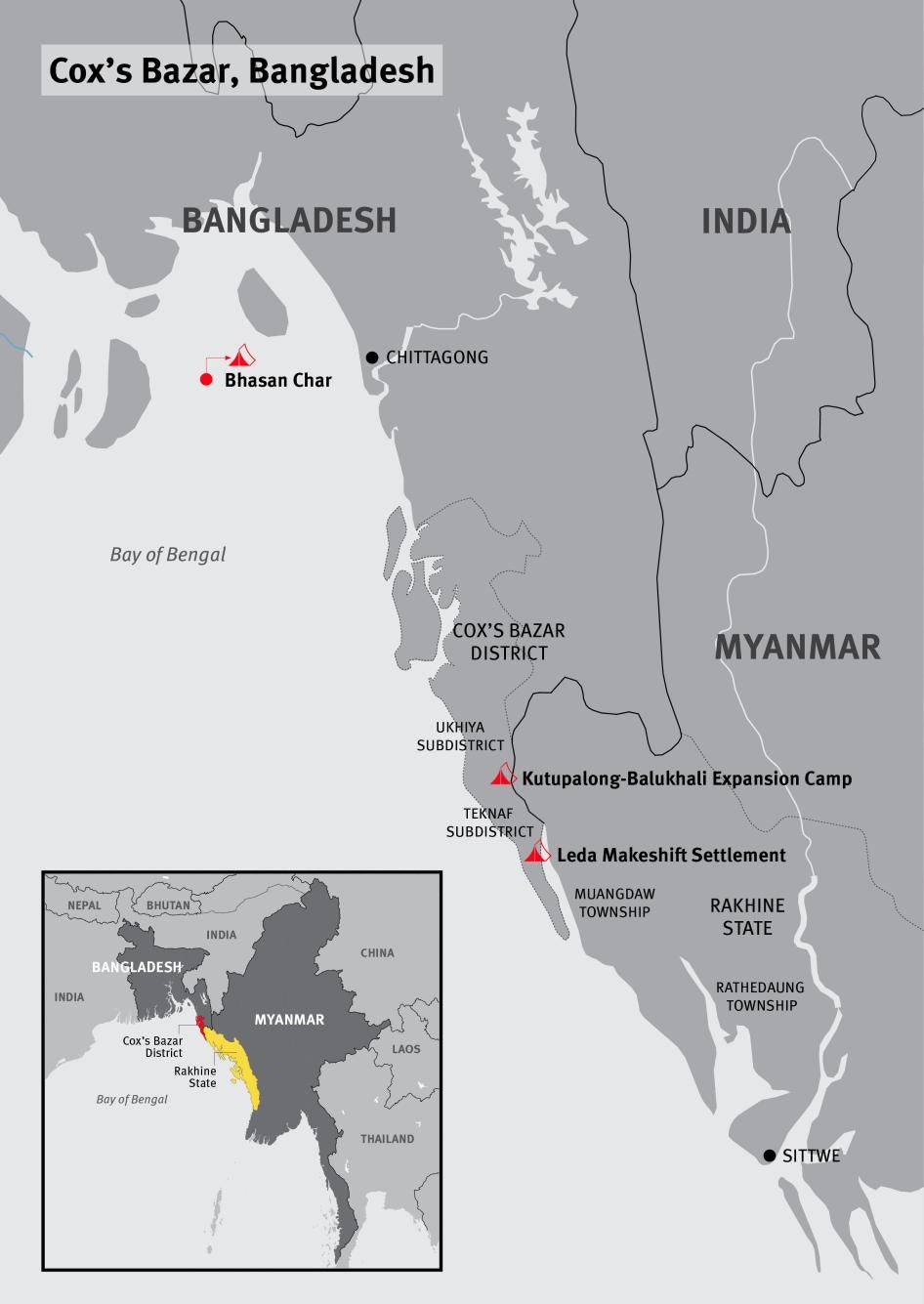
Note: Map not to scale and does not represent authentic international boundaries.Location of the Rohingya refugee camps (Source 2018 Human Rights Watch)
Note: Map not to scale and does not represent authentic international boundaries.
Education and Opportunities within camps
Kutupalong–Balukhali Expansion Camp (20 miles out of the town of Cox’s Bazaar) is the world’s largest and most densely populated refugee camp. Within this and similar camps, the Bangladeshi government has permitted formal education programmes, teaching in the Rohingya mother tongue (rather than Bangla) and adhering to Myanmar’s curriculum. This education is provided with a view to this knowledge being useful to Rohingyas after repatriation, rather than with the intention of integrating them into Bangladeshi society or providing job security within the host community. Many of those receiving education within camps such as Kutupalong were denied access to schools in Myanmar or dropped out due to fear of discrimination and violence.
Hopes of repatriation
Safely repatriating over a million refugees will be an expensive and lengthy process that will require the input of countless domestic and international actors. Myanmar have purposefully manufactured a situation in which it is impossible for the Rohingya population to return. If they do return, they will be faced with a hostile and militant, nationalist, Buddhist movement. In addition, the government of Myanmar has systematically destroyed Rohingya lands and targeted their religious leadership. By destroying the foundations of Rohingya society, Myanmar ensure that the Rohingya are unable to return to their lives if repatriated, and Burmese society functions as if this minority group had never existed.
Note that continuous attempts at repatriation fail through Myanmar’s lack of interest, but also through Rohingya refugees’ awareness of the unsafe and unwelcoming situation they would be returning to.
Bhashan Char
The Bangladeshi government moved 100,000 Rohingya refugees to Bhashan Char, an Island in the Bay of Bengal.[28] Located 123 km away from the camps in Cox’s Bazar, and a 3-hour boat ride from the mainland, this relocation has been met with significant criticism by NGOs and human rights groups.[29]
Chars are temporary land masses that have been revealed through the movement of water. During their colonial rule, the British were unable to decide who these temporary and emerging lands would belong to, meaning that their modern-day inhabitants are an often nomadic and therefore vulnerable population.
Burma Vs Myanmar
Some organisations, such as the National League for Democracy (NLD) refuse to use the name ‘Myanmar’ when referring to the country, a statement of their refusal to accept the legitimacy of the military government.
However, some non-Burman ethnic groups prefer the name Myanmar, since it no longer associates the country with its majority ethnic group.
The Arakan/Rakhine State
Arakan was a sovereign and independent state until 1784, when it was invaded by Burman King Bowdawpaya and annexed to the Burman kingdom. It is now referred to as the Rakhine State, and is one of the seven states of Myanmar. The Rakhine State is one of the poorest regions in the country, with a poverty rate of 78 percent (the national average being 38 percent).[30]
The Rakhine state is composed of a narrow and mountainous strip of land that runs along the east coast of the Bay of Bengal (the west coast of Myanmar), from the Naaf river to Cape Negaris, touching Chittagong (Bangladesh). The Rakhine Yoma Mountains are about 2000 meters tall, physically separating the Rakhine region from the rest of Myanmar. Although the Rakhine region spanned an area of 20,000 square miles during the British colonial period, it is now considered to only apply to an area of 14,200.
Half of Myanmar’s seven million Muslims live in the Rakhine state, including both the Kaman[31] and Rohingya populations. Historians suggest that Muslims first reached Rakhine in the 8th century, and this population expanded to form a distinct community throughout the 15th and 16th centuries. Others, including the government of Myanmar, argue that the Rohingya are descended from Bengali migrants who were allowed to settle by the Mrauk-U Dynasty in the 15th and 16th centuries.
The Rakhine region repeatedly changed hands between Burma and Bengal, particularly during the Mrauk-U Dynasty. Hence, this ‘marginal land’ developed two ethnic groups – the Rakhines and the Rohingyas.[32]
3000 BCE
- The Arakanese chronicles date the origins of the Arakan/Rakhine people to 3000 BCE. Inscriptions from this time were written in Sanskrit, which suggests that Rakhine’s founders were Indian rather than Tibeto-Burman.
500 BCE
- The Pyū enter the upper portion of the Ayeyarwaddy valley.
Ninth Century CE
- Earliest archaeological evidence of the Rakhine people, which suggests that the Rakhine were originally one of the Pyū tribes that crossed the Rakhine Yomo and displaced the indigenous population.
1430-1784 (The Mrauk-U Dynasty)
- Min Saw Mon, who had been overthrown by Min Khaung Yaza 24 years earlier, reclaimed his throne in 1430. He did so with the aid of the sultan of Bengal, Gaisuddin Azam Shah, and brought his Bengali followers to Arakan on his return. These were the earliest Muslim settlers in Rakhine, and the Muslim Mrauk-U dynasty would continue to rule and influence the region until 1784.
- Chittagong changed hands several times during this dynasty. Min Saw Mon ceded southern Chittagong to Bengal as thanks for the sultan’s support in reclaiming his throne. Mon was succeeded by his brother, Min Kahri Ali Khan, who declared Rakhine free of Bengali rule, and Ali Khan’s son later defeated Bengal and reclaimed Chittagong.
- Min Bin Zabuk Shah (r. ca. 1531–1553) defeated Burmese king Tabinshweti’s invasion, occupied east Bengal, and created a naval fleet that occupied and controlled the Bay of Bengal, which received Arab, Danish, Dutch, and Portuguese traders during this period.
- When the Burmans defeated the Mrauk-u Dynasty, they burned mosques, temples and libraries to the ground, and Arakanese artisans and nobility fled to Upper Burma and Chittagong
- At least 60,000 Bengalis moved to northern Rakhine by the end of the 17th century.[33]
1575
- Muslim Bengalis fled to Rakhine State during the Mughal invasion of Bengal.
1700s
- One myth recounts a story of Arab traders who shipwrecked off the Burmese coast. These traders ask for the Rahm (an Arabic word for ‘mercy’) of the local king, who allotted a piece of land for them to settle on. This myth can be used to explain the root of the name ‘Rohingya’. Other explanations for the term ‘Rohingya’ could be that ‘Roh’ means mountain in Sanskrit (since the Arakan is a mountainous region), or that the Rohingya descend from the Ruha people who migrated from Afghanistan.[34]
- Peta Vino’s Latin Geography, published in 1597, referred to this region as ‘Aracan’, but travel literature from the 1500s – 1800s uses various forms such as Rocon, Roshang, Roung and Rossawn. Thus, ‘Rohingya’ is thought by many to illustrate a historical connection to this land.[35]
1783
- Burma recognises Rakhine, and a direct frontier is established between Burma and British-administered Bengal (Chittagong).
1784 - 1785
- Rakhine is invaded by Burman Crown Prince Bowdawpaya and annexed to the Burman kingdom.
- The Burmese occupation of Rakhine was oppressive, and rebellions supported by Arakanese chiefs, rebels and refugees who had fled to Chittagong led to cross-border tensions between Burma and British Bengal. These border disputes endured for several decades, and Burma repeatedly threatened to invade British Bengal, contributing to the eventual outbreak of the first Anglo-Burmese war.
1799
- A Scottish surgeon called Francis Buchanan travelled to Burma and met members of a Muslim ethnic group. He recounts that they had been settled in this land for a long time, and that they referred to themselves as ‘Rooinga’.[36]
1824-1826
- The first Anglo-Burmese war was waged from 1824 to 1826 and ended on 24 February 1826, with the Treaty of Yandabo. According to this treaty, the Burmese ceded Rakhine (as well as several other provinces) to the British.
1886
- Burma becomes a province of British India.
- During the British colonial period, Muslims from India and Chittagong immigrated to Myanmar for work, particularly agricultural labour.
1937
- Burma is ceded from India and becomes a crown colony with its first Prime Minister.
1942 - 1945
- The Allies lost Burma to the Japanese Imperial Army in 1942.
- The Allies and Japan launched multiple offences against each other in Rakhine until the Japanese forces in Burma surrendered in 1945.
1948
- The independent Union of Burma came into existence on 4 January 1948.
- Burma joins the United Nations.
1950
- The first formal acknowledgement of the ethnonym Rohingya was on 10 March 1950, by a group of Arakanese elders addressing the Prime Minister. [37]
- In the 1950s, Burma became fractured, as states such as the Rakhine state were formed.
1989
- The military government changed the country’s name from Burma to Myanmar.
- The military government changed the state’s name from Arakan to Rakhine to standardise place names and ethnonyms.
References
[1] https://www.unrefugees.org/news/rohingya-refugee-crisis-explained/
[2] ibid
[3] Al Marjuk, 2022
[4] Fairooz, 2022
[5] Al Marjuk, 2022
[6] Brinham, 2024
[7] pink for full citizens, green for naturalised citizens
[8] General Khin Nyunt lost power in 2004, and the NaSaKa were replaced by the Border Guard Police in 2013
[9] Afrin Rahman, 2025
[10] ibid
[11] Francis Wade, Myanmar’s enemy within: Buddhist violence and the making of a Muslim ‘Other’ (London: Zed Books, 2017), 29
[12] LeeSource, Ronan. 2019. “Myanmar’s Citizenship Law as State Crime: A case for the International Criminal Court”, State Crime Journal 8, no. 2 (2019): 241–279
[13] Yasmin, 2022
[14] Brinham, 2024
[15] Al Marjuk, 2022
[16] Geopolitics around 2017 shifted towards isolationism e.g. Brexit, Trump withdrawing from 2015 Paris Agreement on climate change mitigation
[17] Myanmar want to use the land historically inhabited by the Rohingya to build a highway connecting Kunmin (China) to Myanmar’s port on the Bay of Bengal
[18] Karim, 2022
[19] Enam Khan, 2022
[20] Afrin Rahman, 2025
[21] Various Authors, American Medical Association, 2018
[22] Brinham, 2024
[23] Afrin Rahman, 2025
[24] In 2018 there were 208 criminal cases filed against members of Rohingya community; that figure increased to 263 cases in 2019, and 78 cases in first half of 2020 - The Daily Star, Aug 28
[25] Devastating effect of the refugee crisis on the tourism industry, described first hand by the author who visited Cox’s Bazar both before and after 2017
[26] Karim, 2022
[27] Biswas, 2022
[28] https://www.nytimes.com/2021/10/10/world/asia/bangladesh-rohingya-bhashan-char.html#
[29] Afrin, 2022
[30] Burke (2016)
[31] The Kaman are accepted by the Myanmar government as an ethnic group, speaking the Rakhine or Burmese language and sharing a culture with the Buddhist population
[32] Bhonsale (2019)
[33] Mohajan (2018)
[34] ibid
[35] ibid
[36] ibid
[37] Bhonsale (2019) and Mohajan (2018)
Bibliography:
https://www.unhcr.org/uk/countries/bangladesh
https://www.unrefugees.org/news/rohingya-refugee-crisis-explained/
https://exhibitions.ushmm.org/burmas-path-to-genocide/timeline
Afrin, Ibtesum, Rohingya Refugee Future: Narratives from History, Memory, & Relocation (Rohingya Camp Narratives, Tales From the ‘Lesser Roads’ Travelled, Edited by Imtiaz A. Hussain, 2022)
Afrin Rahman, Farhana, After the Exodus, Gender and Belonging in Bangladesh’s Rohingya Refugee Camps, 2025
Akter, Marufa, Sexual/Gender-Based Camp Violence and Institutional Response Limits: Rohingyas in Bangladesh (Rohingya Camp Narratives, Tales From the ‘Lesser Roads’ Travelled, Edited by Imtiaz A. Hussain, 2022)
Al Marjuk, Obydullah, Ethnicity, Identity, and Rohingya Security: At the ‘Olive Tree’–‘Lexus’ Crossroads (Rohingya Camp Narratives, Tales From the ‘Lesser Roads’ Travelled, Edited by Imtiaz A. Hussain, 2022)
Bhonsale, Mihir, Crisis in the Rakhine State of Myanmar, Bilateral relations with India in Perspective, 2019
Brinham, Natalie, Citizenship and Genocide Cards, IDs, Statelessness and Rohingya Resistance in Myanmar, 2024
Burke, Adam, New Political Space, Old Tensions: History, Identity and Violence in Rakhine State, Myanmar, 2016
Dittmer, Lowell, Burma or Myanmar? The Struggle for National Identity, 2010
Enam Khan, Shahab, The Political Economy of Religion and Security: Tracing Rohingya Camp Violence (Rohingya Camp Narratives, Tales From the ‘Lesser Roads’ Travelled, Edited by Imtiaz A. Hussain, 2022)
Fairooz, Subaita, Rohingya Refugees and Human Security: Foreign Policy Reform Needs (Rohingya Camp Narratives, Tales From the ‘Lesser Roads’ Travelled, Edited by Imtiaz A. Hussain, 2022)
Hussain, Imtiaz A., Rohingya Refugee-Camp Innovations: Reinvigorating Humanitarianism (Rohingya Camp Narratives, Tales From the ‘Lesser Roads’ Travelled, Edited by Imtiaz A. Hussain, 2022)
Hussain, Imtiaz A., Rohingya Circle: Left Unbroken, Squared, or to Evaporate? (Rohingya Camp Narratives, Tales From the ‘Lesser Roads’ Travelled, Edited by Imtiaz A. Hussain, 2022)
Karim, Tariq, Rohingya Conundrum: Cutting the Gordian Knot? (Rohingya Camp Narratives, Tales From the ‘Lesser Roads’ Travelled, Edited by Imtiaz A. Hussain, 2022)
Mohajan, Haradhan, History of Rakhine State and the Origin of the Rohingya Muslims, 2018
Rasheeka, Raisa, Vulnerability and Humanitarian Emergencies: Fate of Rohingya Women Amid Covid-19 (Rohingya Camp Narratives, Tales From the ‘Lesser Roads’ Travelled, Edited by Imtiaz A. Hussain, 2022)
Ranjan Biswas, Niloy, Identity, Intersectionality and Refugees in Cox’s Bazaar: Remaking Rohingyas? (Rohingya Camp Narratives, Tales From the ‘Lesser Roads’ Travelled, Edited by Imtiaz A. Hussain, 2022)
Suma, Jessica Tartila, Rohingya Refugees and Classroom Children: Cultivating a Lost Generation (Rohingya Camp Narratives, Tales From the ‘Lesser Roads’ Travelled, Edited by Imtiaz A. Hussain, 2022)
Topich, William J., Leitich, Keith A., The History of Myanmar, From The Greenwood Histories of the Modern Nations, 2013
Yasmin, Lailufar, From Disorganized Hypocrisy to Political Neo-medievalism: Rohingya Crises in Bangladesh (Rohingya Camp Narratives, Tales From the ‘Lesser Roads’ Travelled, Edited by Imtiaz A. Hussain, 2022)
Various Authors, Research Letter, American Medical Association, April 2018, Volume 319, Number 14