

What You Are Looking For Is In Nilkhet
Nilkhet, one of the most famous places in Bangladesh, preserves history not only through its name but also through the countless stories that have lived there for decades.
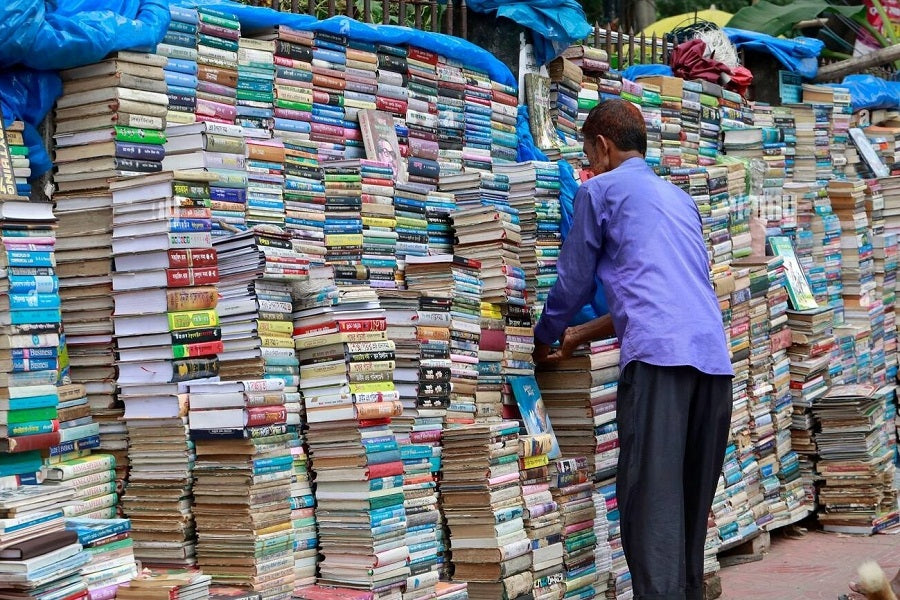
While the name 'Nilkhet' instantly conjures the image of a sprawling book market, this iconic Dhaka landmark has gone beyond this function. It has become a lively, multi-service center where the pursuit of knowledge is intrinsically combined with daily needs.
Besides its towering stacks of books, the place is full of necessary stationery, food, and trustworthy printing, photocopying, and binding services. As a result, Nilkhet has become a common gathering place for students, academics, and even casual visitors who just want to stroll around.
The Story Behind The Name 'Nilkhet'
The name 'Nilkhet' tells its own history when broken down. 'Nil' means 'blue', specifically referring to Indigo, and 'Khet' means 'field'. To trace its origin, we need to go back to the British colonial period in Bengal (1757-1947).
Indigo cultivation was widespread during this era. By 1847, records show thirty seven Nilkuthis (indigo plantation houses) in Dhaka alone. It is strongly believed that the name 'Nilkhet' evolved from these very Nilkuthis, denoting a field where indigo was cultivated and processed.[1]
This historical reality stands in stark contrast to the Nilkhet of today. It is now one of the busiest commercial hubs in Bangladesh, making it difficult to imagine that this vibrant area was once a sparsely populated indigo field, its identity rooted in the colonial dye trade.
The Metamorphosis of Nilkhet
From Indigo Fields to a Universe of Ink
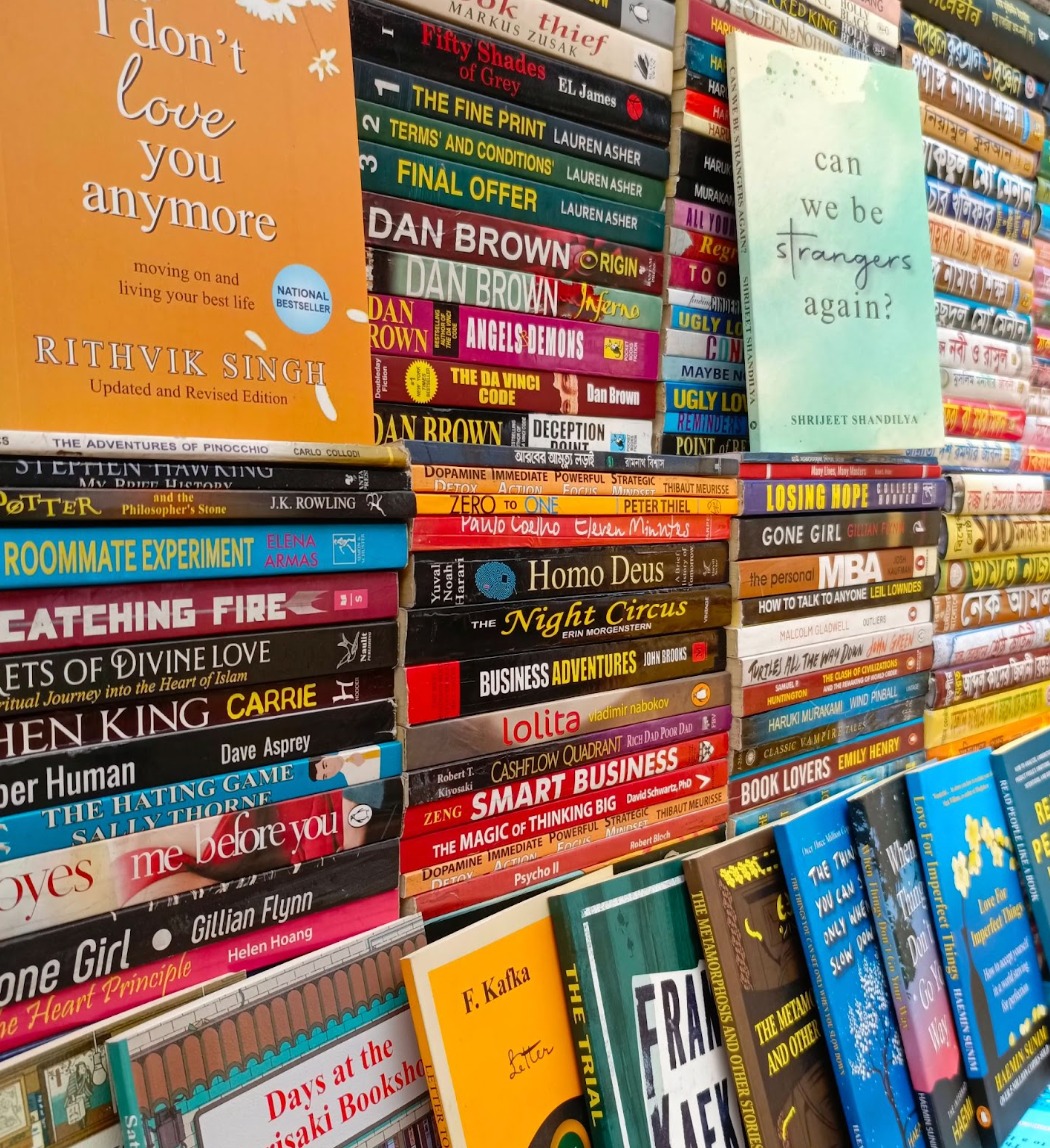
Nilkhet did not become a book market overnight, its conversion was gradual. After the closure of indigo cultivation, the area was used as a racecourse stable until 1971 and later turned into a settlement for the homeless people. The first traces of bookselling appeared around 1974 when street vendors used to carry books in baskets for an informal sale. In no time, a few bookstores were opened to cater to the increasing demand of the students. The number of shops kept increasing from the 1980s. By the 1990s, Nilkhet had completely wiped out its history and consolidated its characters of being the largest book market of Dhaka.[2]
Nilkhet's Shift from Book Haven to Book Hub
Nilkhet's story began as a true sanctuary for book lovers. It was that place where people could lose themselves for hours among the countless shelves of literature, philosophy, and history. It has been a destination for the inquisitive minds for generations. The lively and serpentine aisles of Nilkhet have not changed but the focus has changed to guides, textbooks, and materials for competitive exams.
This is not a loss of soul but rather an adaptation. The classic novels and poetry collections are still there; they have just been relocated from the bright front displays to the quieter shelves at the back. Nilkhet has transitioned from a tranquil refuge to a lively center, deeply committed to assisting students and job-seekers in finding their way, thus demonstrating that even a book market can grow with the readers' needs.
Nilkhet's Pandemic Pivot
When the COVID-19 pandemic came and the strict lockdowns made Dhaka silent, Nilkhet faced its greatest threat in decades. The busiest lanes which were previously full of students and their noise became deserted. Stores closed down and the community's way of life came to a halt. The shopkeepers took time to understand the situation and went for a digital transition to avoid further loss. They started using Facebook pages, WhatsApp orders, and courier services that cover the whole country. As a result, their destination was completely changed. Nilkhet did not confine itself to Dhaka anymore. They were sending necessary textbooks and guides to students in different cities, towns, and villages of Bangladesh. Such a courageous turn around not only rescued the market but also re-established it, demonstrating that even the most ancient center could change, link up and be at the disposal of a whole nation in a time of disconnection.
The Secrets Behind Nilkhet's Enduring Popularity
A Fortunate Geography
Nilkhet's rise as Dhaka's indispensable academic hub is a direct result of its exceptional location. It sits at the vital center of the city's most concentrated educational zone. Its geography places it within walking distance or a short commute from nearly every major institution in the area: the University of Dhaka, Dhaka College, Bangladesh University of Engineering and Technology (BUET), Dhaka Medical College, Sir Salimullah Medical College, Eden Girls' College, and countless schools and coaching centers.
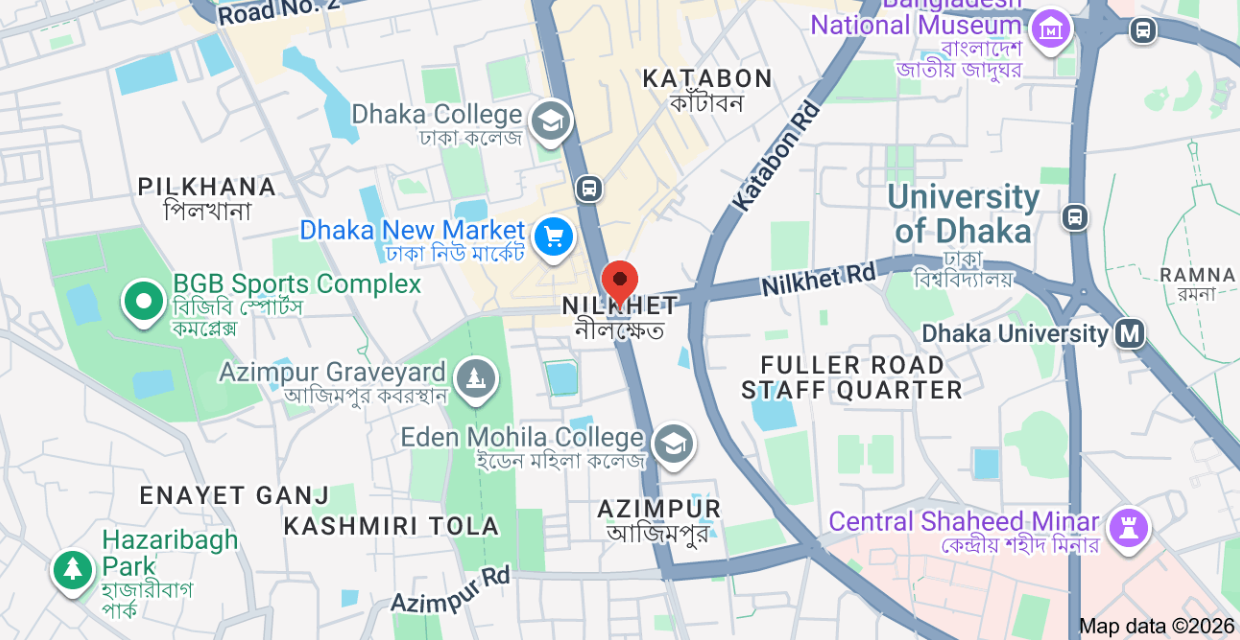
Such a place has obviously become the very everyday meeting point for a huge number of students, teachers, and scholars. Being accessible from Mirpur Road, Nilkhet Road, and other linking streets, it has turned into the academic commons that are shared by the whole area. This good luck with geography gave a fixed, continuous stream of people, hence making a simple market the key, the city-wide, every academic need-gathering place.[3]
Nilkhet on map
What You Are Looking For Is In Nilkhet
Nilkhet fulfills the needs of anyone connected to learning, ensuring that what they are looking for is here. It is a paradise for students seeking textbooks, guides, or rare second-hand finds, yet its reach comfortably extends to teachers, professionals, and parents gathering school supplies. Many also visit simply to browse the endless shelves or to enjoy a thoughtful stroll through its lively, book-lined lanes.
The market is filled with academic services beyond the supply of books. It is common to find shops that can quickly print, bind or photocopy, and at the same time, there is an enormous selection of stationery items ranging from fine art papers and sets of geometry to different types of school uniforms. It doesn't matter whether the request is for document lamination, poster designing, or thesis formatting; there will always be a professional for it. Nilkhet offers both knowledge and the tools to organize it. This rich variety makes it Dhaka's most vital academic hub. No one ever leaves Nilkhet empty-handed.
The Nilkhet Price Tag
One major factor behind Nilkhet's long-standing popularity is how it lets people have a trip to the book world sit well in their budget by the 'Nilkhet price tag' In a city where the price of education and books can be frightening, this market plays as a very important equalizer. Students get the textbooks and study guides at the market at a very low cost compared to the original prices because there is a great flow of second-hand books, and new ones are also sold at very competitive prices. This, in turn, means that good quality academic materials become affordable to students who come from different walks of life and have limited means.
In fact, Nilkhet is more than just a market; it is a democratic gateway to the world of knowledge, where a book's price can never hinder one from reaching for the stars.
The Ethical Crossroads of Nilkhet
Nilkhet is at an impasse where it is torn between its identity and its survival. One side is a continuation of its original nature, a refuge for freely shared knowledge, where used books were exchanged between readers at a minimal cost, and where small shopkeepers were familiar with their customers. In this way, the values are accessibility, community, and the simple love of books.
The second path is an illustration of compromise and modern necessity. It is not merely stocked with the mass-produced guidebooks but also with the notoriety of pirated copies sold at a cheap price and thus meeting the immediate demand of the students but depriving the authors and publishers of their rightful gains. This truth is the market's confounding problem; it is in the predicament of deciding whether to provide accessible knowledge or to respect the labor that creates it.
The crux of Nilkhet's issue is its ability to live with this dilemma. It is a place that has to remember its past culture while still dealing with the present complexities of the ethics in the real world. The hope is that it will strike a compromise where the low price will not be a pretext for the loss of integrity, and the progress will be made without the disappearance of the respectful purpose that made it loved.
The Hidden Lives in Old Books
Besides textbooks and guides, Nilkhet's old shelves store an even quieter treasure: used books that reveal not only other worlds but also other lives. It is very likely to find a student's serious note in the margins of the old philosophy book. Lovers of the novel might find a faded birthday card or a dried flower that communicates a silent story of its previous owner. These personal traces, underlines, heartfelt inscriptions, or even a shopping list on a bookmark turn a simple purchase into a touching discovery.[4] For many people who are there, these are part of the continuing charm of Nilkhet.
Nilkhet is not simply a marketplace for books, but a site where history seems tenderly preserved. By discovering these fragments, one gains not only knowledge but also, for a short time, a hidden, human past that is tucked between the pages.
References
[1] https://www.shampratikdeshkal.com/art-literature/162998
[2] https://www.facebook.com/watch/?v=626060534691279&rdid=QGm4KuEk4hFgztSe
[3] https://dhakamail.com/arts-and-literature/258188
[4] https://dhakamail.com/arts-and-literature/258188