




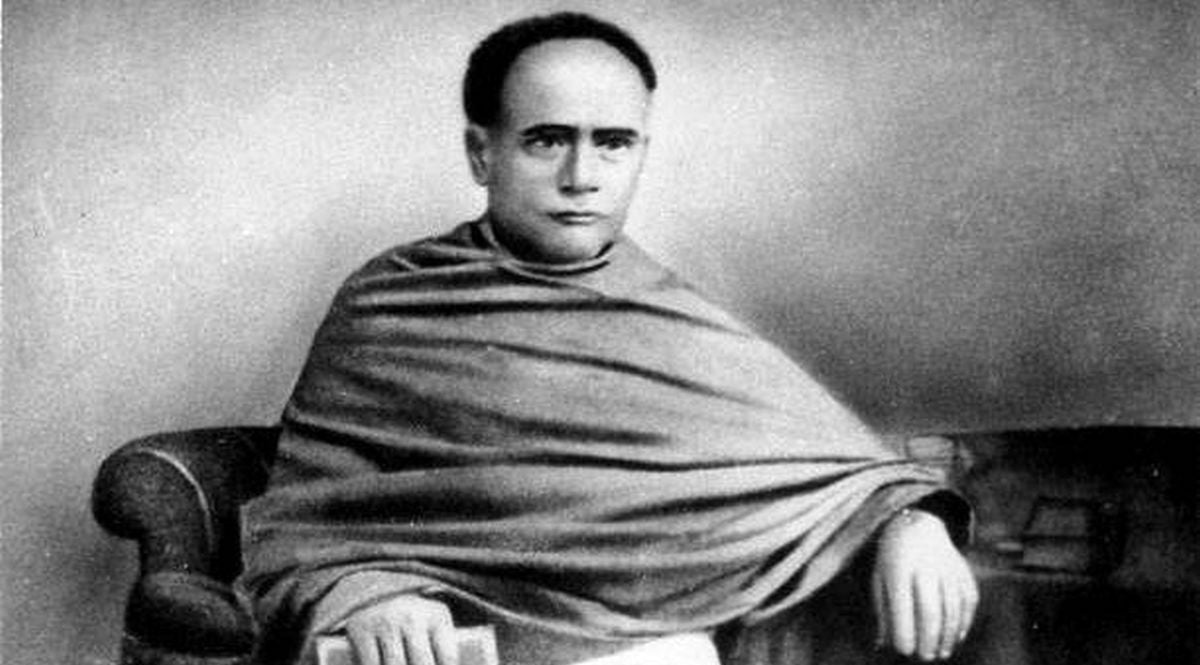
Biography
Name: Ishwar Chandra Vidyasagar
Born: 26 September 1820, Birsingha
Died: 29 July 1891
Known both as ‘Vidyasagar’ (the sea of knowledge) and ‘dayar sagar’ (ocean of kindness).
Before age 20, Vidyasagar graduated from Sanskrit College (Kolkata) and cleared his law exams.
Known to have studied under a streetlamp as a child, since his family could not afford a gas lamp for the home.
Educational Reform
Although traditional Sanskrit schools were already established throughout Bengal, Vidyasagar reformed the education system in Bengal by establishing vernacular schools. These schools were modelled on Western school systems, and taught modern scientific knowledge in Bengali. Thirty of the schools founded by Vidyasagar in Bengal were specifically for girls, as he acknowledged that women could not be free of inequality until they were granted access to education. More than this, Vidyasagar made house calls to request that parents sent their daughters to these schools.
Vidyasagar travelled Bengal as a school inspector and established twenty schools in the space of two months, in reaction to the lack of available education he witnessed. A Sanskrit College (Kolkata) graduate, Vidyasagar became its principal in 1851, extending admissions to students of all castes (only Brāhmins were allowed to study in Sanskrit College until this time).
Influence on the Bengali language

Vidyasagar is often referred to as the father of the modern Bengali school system. Most notably, he authored Barna Parichay, the first primer of the Bengali alphabet introduced to children, which is still used today. Vidyasagar standardised the Bengali language through the publication of his textbooks, creating the language as we know it. He invented terminologies for words that did not yet exist in Bengali (e.g. upakool/coast), published countless textbooks, and simplified Bengali typography into an alphabet of 12 vowels and 40 consonants.
Social Reform
Vidyasagar’s mother influenced him to turn his attentions towards social justice for women, who at the time were often treated as a burden by society. In particular, he is credited for his contributions to the passing of the Act of 1856, which, in some cases, legalised widow remarriage. His study of ancient religious texts revealed to him that the inequality faced by women in nineteenth-century Hindu society was not legitimised by these scriptures but rather by existing societal power relations, and he made sure to share this knowledge through his campaigning. Vidyasagar campaigned through a range of methods; educating through seminars, meeting with government officials, and publishing books on issues such as the remarriage of widows and abolition of polygamy, citing scriptures to legitimise his arguments. He also established the ‘Hindu Family Annuity Fund’ to help widows who could not remarry, and funded weddings for widows seeking to remarry.
Context around the Hindu Widows’ Remarriage Act of 1856
When the British colonised India in the late 18th century, there were several contrary systems of law coexisting, such as Hanafi and Ithan Ashari Muslim Law, the Dayabhaga and Mitakshara schools of Hindu Law, and traditions of Customary Law. Although the British worked with their colonial subjects to translate and uphold existing Hindu laws, their approach to legislation overlooked Customary Law. Lucy Carroll cites The Hindu Widows’ Remarriage Act as an example of ‘the role of the judicial branch of the British Raj in the process of propagating values of orthodox Hinduism and ’Hinduising’ castes and tribes on the fringes of Hinduism’.[1]
Under the Hindu Law administered by the British-Indian courts, the remarriage of higher caste Hindu widows was forbidden, meaning that any children of the remarriage were illegitimate. Kulin Brāhmin polygamy was a social custom by which teenage girls were left widowed by their elderly husbands. These women would be expected to wake early, bathe in freezing water, wear only plain white cotton saris, keep their heads shaved, and observe a range of religious fasts, among other things. Some, on being returned to their parental homes, would be forced out and therefore left victim to poverty and crime.[2]
Under the Dayabhaga and Mitakshara schools of Hindu law, a widow only inherited her husband’s estate if the deceased did not have a male heir (namely a son, grandson, or great grandson). Upon her death, the estate would then be passed to the closest heir of her deceased husband, rather than her own heirs.
The Hindu Widows’ Remarriage Act (Act XV of 1856) stated that:
- ‘no marriage contracted between Hindus shall be invalid, and the issue of no such marriage shall be illegitimate, by reason of the woman having been previously married or betrothed’
- A widows rights to her deceased husbands property end if she remarries
- ‘every widow who has re-married shall have the same rights of inheritance as she would have had, had such marriage been her first marriage’
Reactions to the Hindu Widows’ Remarriage Act of 1856
The Hindu Widows’ Remarriage Act was met with significant resistance and contention. The wording was unclear, and therefore High Courts could contest sections of the Act and continue to rule according to their preference. The High Courts of Bengal, Bombay and Madras held that section 2 (A widows rights to her deceased husbands property will end if she remarries) applied to all Hindu widows, regardless of whether the validity of their marriage derived from this act. Meanwhile, the High Court of Allahabad maintained that the Act did not apply to those who were permitted by Customary Law to remarry before 1856.
Lucy Carroll finds that few women availed themselves of their new right to remarry.[3] Those widows who had, by Customary Law, remarried before the Act was passed (or, through customs that predated the act) were now restricted by section 2, which demanded that they forfeit the property of their first husband. Therefore, while this act was certainly a milestone of social reform brought about by the thinking and figures of the Bengali Renaissance, its limitations should not be overlooked.
References
[1] Carroll, 1983
[2] Note that the lower casts (about 80% of the population) did not practice child marriage or prohibit the remarriage of widows
[3] Carroll, 1983
Bibliography
Basu, Sibaji Pratim, Ishwar Cahndra Vidyasagar (Revisiting Modern Indian Thought: Themes and Perspectives, edited by Suratha Kumar Malik, Ankit Tomar, 2022)
Carroll, Lucy, Law, custom, and statutory social reform: the Hindu Widows’ Remarriage Act of 1856, 1983
https://www.britannica.com/biography/Isvar-Chandra-Vidyasagar
https://vclibrary.wordpress.com/wp-content/uploads/2012/02/ishwar-chandra-vidyasagar.pdf