




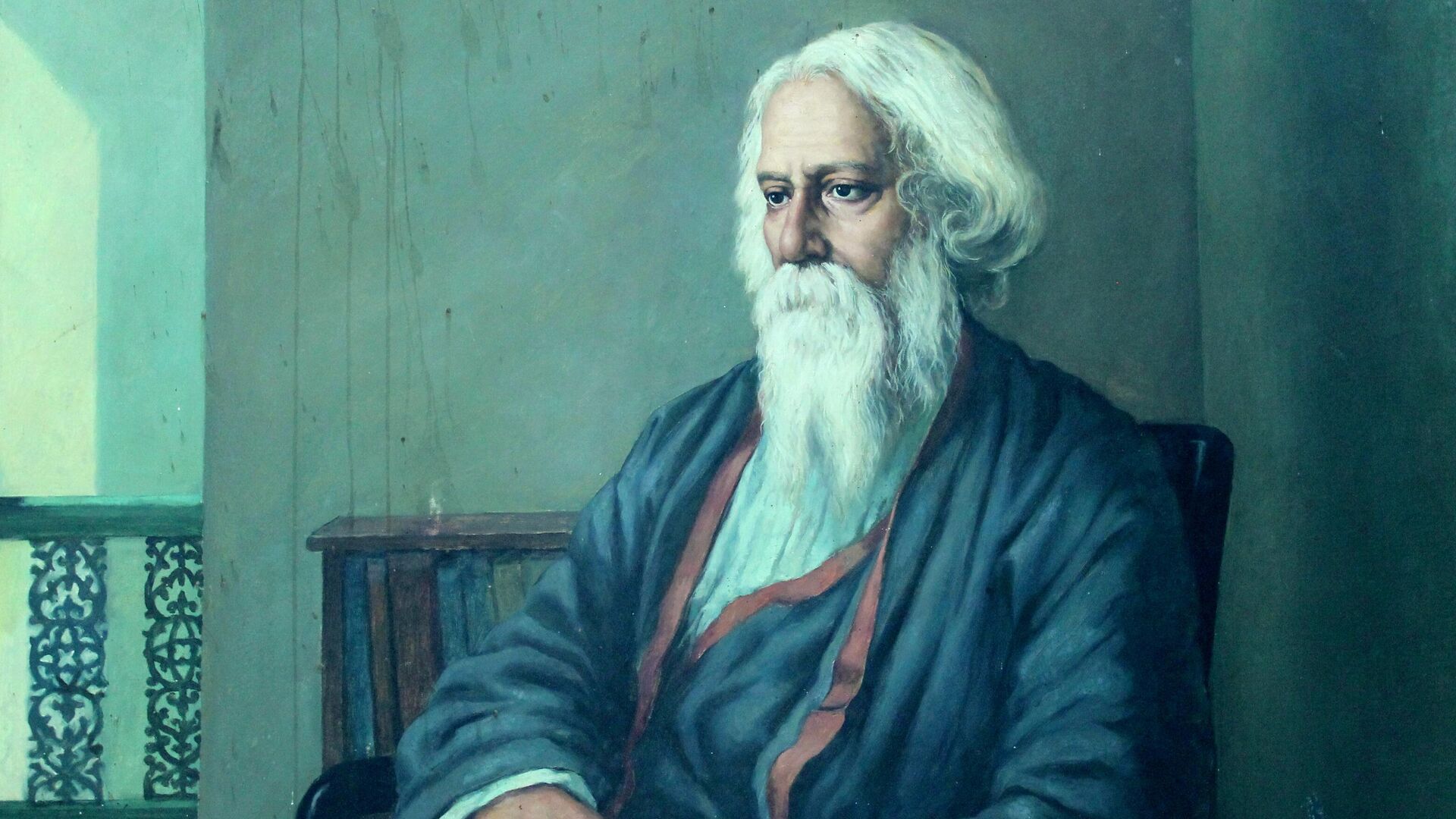
Childhood
Rabindranath (Rabi) Tagore was born on May 7th, 1861 in Calcutta, India. Although born in modern day India, he is a Bengali Brahmin with ancestral roots from Jessore district, Bangladesh. His father, Debendranath Tagore, studied philosophy and was a religious reformer. [2] His father was active in Brahmo Samaj, Society of Brahma/ God which can later be seen to have had an impact on Rabi Tagore's work. Tagore grew up in an affluent household and was raised mainly by servants. His mother, Sarada Devi, passed away in his early childhood. [1]
Early Career
By 1877, Tagore left India to study in England. He studied at University College in Brighton, East Sussex, in law and English literature. He was quickly displeased at the Western curriculum and within 14 months returned to India. He continued writing and published several poetry books. [3] Additionally, he managed his family's properties and estates. The traveling that management required allowed him to better learn about the different regions surrounding his homeland and further inspired his poetry. As stated by Uma Das Gupta, his interest in social reform is attributed to his traveling for work.
Recognition
Tagore translated many Western works to Bangla and vice versa, however, he is most notable for his original work in Bengali poetry. [4] He has written over fifty poems and received recognition globally. His poetry include "Manasi (1890) [The Ideal One], Sonar Tari (1894) [The Golden Boat], Gitanjali (1910) [Song Offerings], Gitimalya (1914) [Wreath of Songs], and Balaka (1916) [The Flight of Cranes]. The English renderings of his poetry, which include The Gardener (1913), Fruit-Gathering (1916), and The Fugitive (1921),... Gitanjali: Song Offerings (1912)." [4]
His works not only portray fiction, but meld nonfiction into each piece as he dives into topics regarding social issues and philosophy. In 1913, he was the first Asian poet to win a Nobel Prize in Literature for his work, Gitanjali, a series of poems. [5][10]
Nationalism
As stated earlier, Tagore was born into a highly political family, naturally this drew Tagore to become engaged with the Swadeshi Movement. [8] The Swadeshi Movement translates to "of one's own country' and the movement encaptures the protests against the 1906 partition of Bengal by colonial government. [9] Tagore pushed heavily for the independence of India and the Swadeshi Movement to boycott all British goods and protect the Indian capital. [9] "Tagore is of the opinion that the spirit of nationalism was derived from the construction of the European nation-state which was the embodiment of capitalist and parochial ideologies. Thus, he believes that this conception of nationalism is intrinsically inimical to the Indian tradition of self-autotomy, pluralism and religious tolerance which one would find in what he calls the "Samaj". Tagore is so indignant about the tyrannical aspects of Western nationalism that he calls it "the worst form of human bondage… which keeps men hopelessly chained in loss of faith in themselves." (Das, Swapnajeet, 3) [8]
After learning about Western nationalism and which traits he believed held back society, he helped establish a different form of nationalism for India. He believes in love for the land. "He no longer wishes to stick to orthodox Hindu nationalism and proposes "…Today I am really an Indian! In me there is no longer any opposition between Hindu, Mussalman, and Christian. Today every caste in India is my caste, the food of all is my food…" (Das, Swapnajeet, 4) [8]
His definition of nationalism was love for the land and love for each other (humanity).
Cultural Importance
Despite being a Hindu writer and poet, his work reached those of other religions as he wrote about the experience of being human and an Indian experiencing the impact of colonialism – something all Indians experienced in the country regardless of religion. Tagore's work criticized the concept of losing a life for freedom as any life lost would be a tragedy to the heart of humanity. Tagore did not discriminate depending on someone's religion, he worked to ensure all were included and all would one day experience education and a life without Western colonialism. [8]
Creation of a University
Tagore went on in life to reimagine and reinvent what he believes the education system should entail. Tagore became the founder of Visva-Bharati University at Santiniketan in rural southern Bengal. [7] He created this institution to actively combat the colonial system of education that was already in place by the British in India. The school first began in 1901 with an experimental approach that quickly developed to bring both people from large cities and villages to attend. [7]
The university began accepting international students in 1921 to truly capture Tagore's efforts of making India as a model for education and not solely sending Indian students to England for studies. He became a large advocate for education revision and rural reform. His three goals for this institution were:
"Firstly, education rests where there is a natural field for the growth of scholarly learning; the purpose of a university is to produce scholarship and to spread it; to do this it was necessary to invite intellectuals and scholars who were devoted to research and discovery and creativity in their fields. A meeting-place of those minds was conceived to be the right venue for a true university. He believed with certainty it would not work to imitate a foreign university.
Secondly, in every nation education is intimately associated with the life of the people; but for us in modern India, the colonial education was applied only to turning out clerks, lawyers, doctors, magistrates, munsiffs and policemen, which were the few favourite professions of the gentle folk. This education did not reach the majority of Indians like the farmer, the oil-grinder, the potter, because our new universities had not been a growth from the soil; they were like "parasites feeding on foreign oaks," he wrote. Tagore argued that a truly Indian school must from the very beginning implement its acquired knowledge of economics, of agriculture, of health and all other everyday sciences in the surrounding villages; then alone can that school become the centre of the country's way of living. This was the Viswakarma approach of his Visva-Bharati institutions at Santiniketan and Sriniketan, or the approach of total activity.
![Photo [12]](https://i.gyazo.com/26ce22abd120706142805dcddb5fce4e.png)
Thirdly, Tagore held that the Indian National Congress followed a faulty policy of petitions and pleas for favours from the colonial government, which he critiqued as the 'politics of begging'; he recommended instead the need to plunge into constructive work by taking responsibility for one's own state and society both as individuals and as collectives so that change could happen." [7]
Death
Tagore's health started to decline at the age of 76 years old. On September 10th, 1937, he first lost consciousness for two days and was quickly diagnosed with kidney and prostate problems. [11] Despite his deteriorating health, he was committed to continue writing poems, essays, and songs as he believed his life had meaning 'beyond mortal diseases.'
Upon receiving his diagnoses, he scheduled a trip in nature, Kalimpong, where his daughter in law resided in 1940. Within a week he lost consciousness again. He was immediately moved to Jorasanko to receive emergency treatment. [11]
He was then diagnosed with uraemia (now confirmed prostate cancer). After attempting treatment on August 5th, his condition worsened and his kidneys stopped working. [11]
Due to such health complications, Tagore passed away August 7th, 1941 at the age of 80. [11]
References
[1] https://www.britannica.com/biography/Rabindranath-Tagore
[2] https://www.britannica.com/biography/Debendranath-Tagore
[3] https://poets.org/poet/rabindranath-tagore
[4] https://www.nobelprize.org/prizes/literature/1913/tagore/biographical/
[5] https://www.nobelprize.org/prizes/literature/1913/tagore/article/
[6] https://allpoetry.com/Gitanjali
[7] https://journals.uni-lj.si/as/article/view/2895/2532
[8] https://www.ijfmr.com/papers/2023/5/7264.pdf
[9] https://www.cambridge.org/core/blog/2020/10/20/nationalism-capitalism-and-the-swadeshi-ovement-in-colonial-india/
[10] https://www.erudit.org/en/journals/efg/2017-n27-efg03613/1054400ar/
[11] https://www.daily-sun.com/post/497826
[12] https://www.nobelprize.org/prizes/literature/1913/tagore/biographical/