



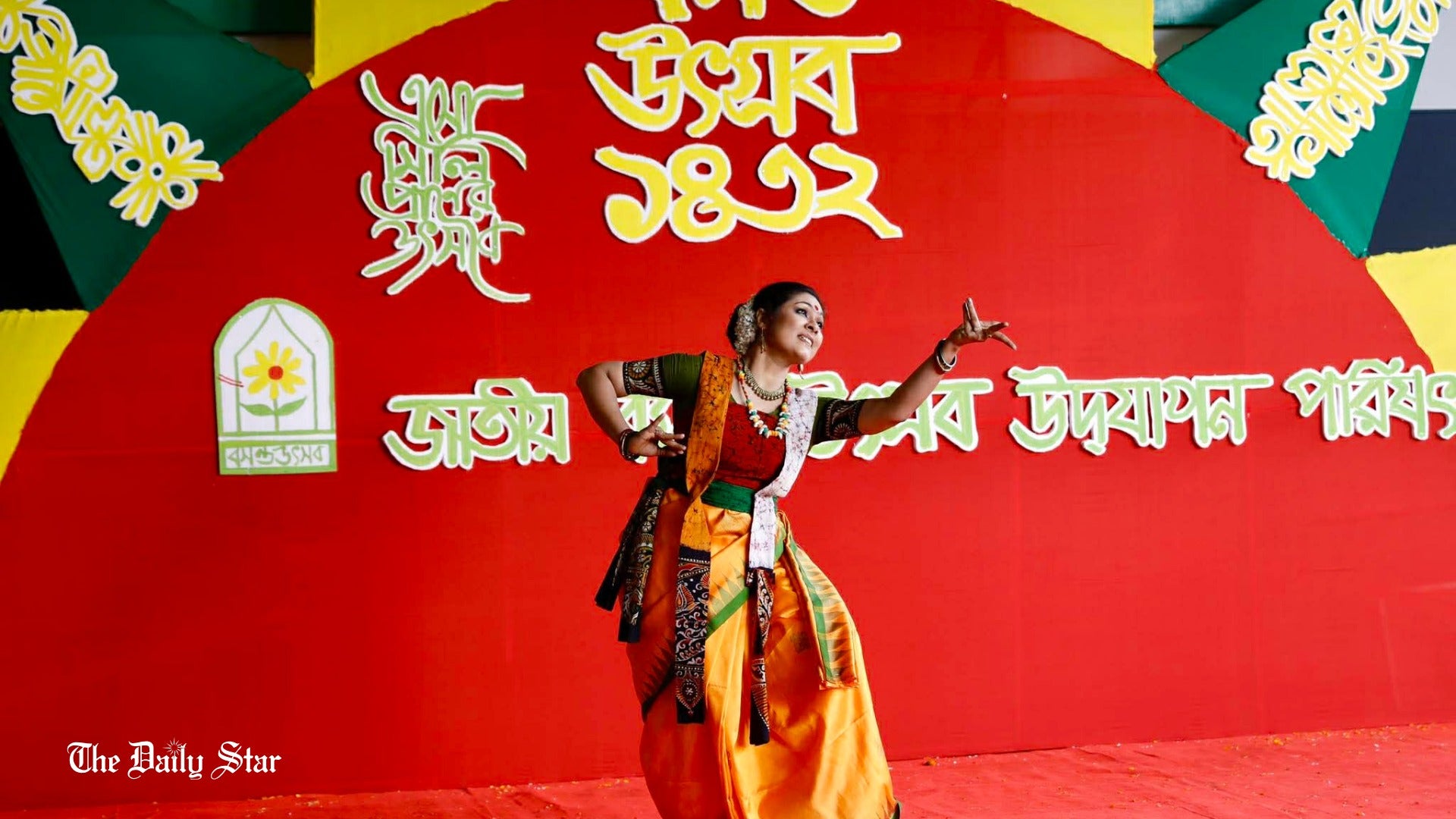
Every year, as winter loosens its brief grip on Bengal, the month of Falgun arrives in colour. Pohela Falgun (পহেলা ফাল্গুন), the first day of Falgun, marks the beginning of Boshonto (বসন্ত), spring, in the Bengali calendar, and is celebrated across Bangladesh with flowers, music, poetry, and a vivid palette of spring colours.
The Bengali Calendar
Unlike the Gregorian calendar, the Bengali calendar divides the year into six distinct seasons, each with their own unique attributes:
- গ্রীস্ম / Grishmo (Summer): Boishakh & Joishtho (বৈশাখ & জ্যৈষ্ঠ)
- বর্ষা / Borsha (Monsoon): Ashar & Srabon (আষাঢ় & শ্রাবণ)
- শরৎ / Shorot (Autumn): Bhadro & Ashshin (ভাদ্র & আশ্বিন)
- হেমন্ত / Hemonto (Late Autumn/Harvest): Kartik & Oghrayon (কার্তিক & অগ্রহায়ণ)
- শীত / Sheet (Winter): Poush & Magh (পৌষ & মাঘ)
- বসন্ত / Boshonto (Spring): Falgun & Choitro (ফাল্গুন & চৈত্র)
Pohela Falgun thus symbolises not just a new month, but the cyclical renewal embedded in Bengal's agrarian and therefore cultural consciousness[1].
The origins of the Bengali calendar are complex and contested, but it remains culturally important. Many historians trace its early foundations to King Shashanka (7th century CE), yet the calendar's modern administrative form is often associated with the Mughal emperor Akbar (16th century CE), whose reign saw attempts to align timekeeping with agricultural cycles.
According to several scholars, Akbar commissioned his astronomer to develop a calendar that blended the lunar Islamic Hijri calendar with the solar agricultural rhythms of Bengal, primarily to facilitate land revenue collection[2], allowing taxes to be collected after harvests rather than according to a drifting lunar year[3][4].
Over time, this calendar has become deeply embedded in Bengali cultural life, transcending its bureaucratic origins.
Celebrating Pohela Falgun
Across Bangladesh, Pohela Falgun is celebrated with enthusiasm, but Dhaka University's Faculty of Fine Arts (চারুকলা/Charukola) remains the epicentre of festivities, particularly at Bakultala (বকুলতলা), where programmes begin at dawn with classical dance, chorus songs, poetry recitations, and colourful processions[5].
A tradition that began informally in 1991, when students of the Faculty of Fine Arts painted block prints onto saris overnight and marched to the sound of music from their childhood, carrying colourful handmade paper flowers, butterflies, and birds, has since grown into a nationwide cultural event. These initial celebrations went beyond seasonal celebrations, as they emerged shortly after the fall of the Ershad regime, reflecting a reclamation of cultural expression.
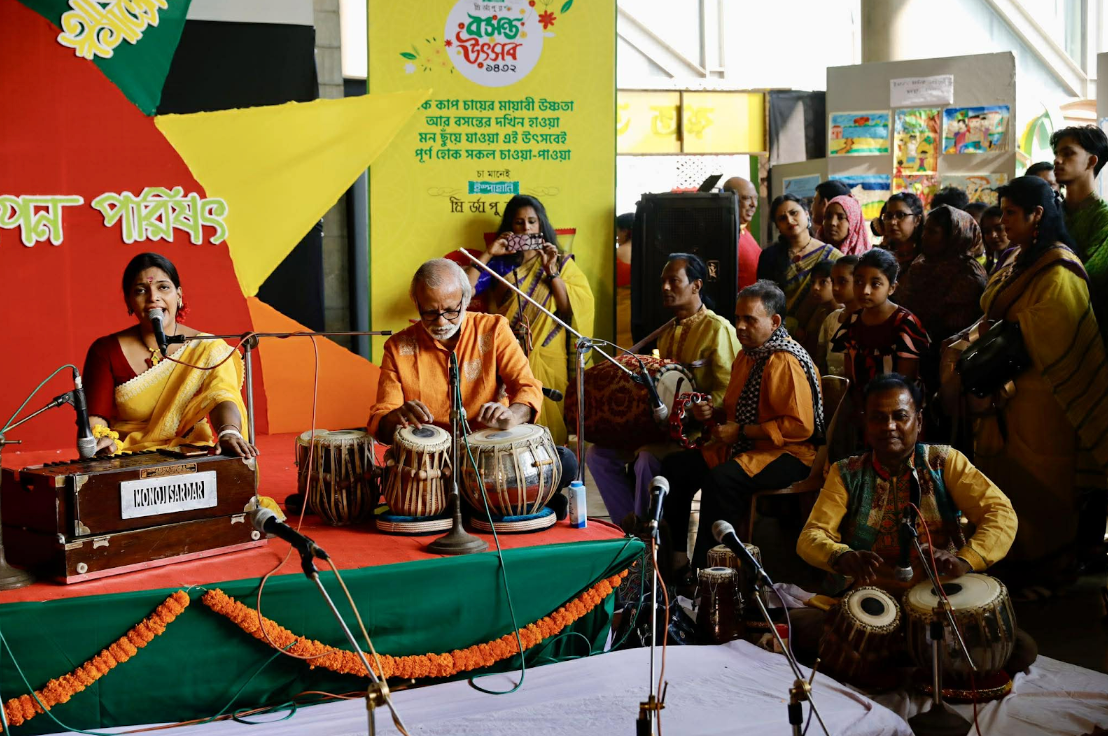
Beyond the university campus, Ramna Botomul (রমনা বটমূল) also hosts significant celebrations, while organisations such as Chhayanaut (ছায়ানট), Shishu Academy (শিশু একাডেমি), and Jatiyo Boshonto Utshob Udjapon Porishod (জাতীয় বসন্ত উৎসব উদ্যাপন পরিষদ) organise music, dance, and folk performances throughout the city[6][2].
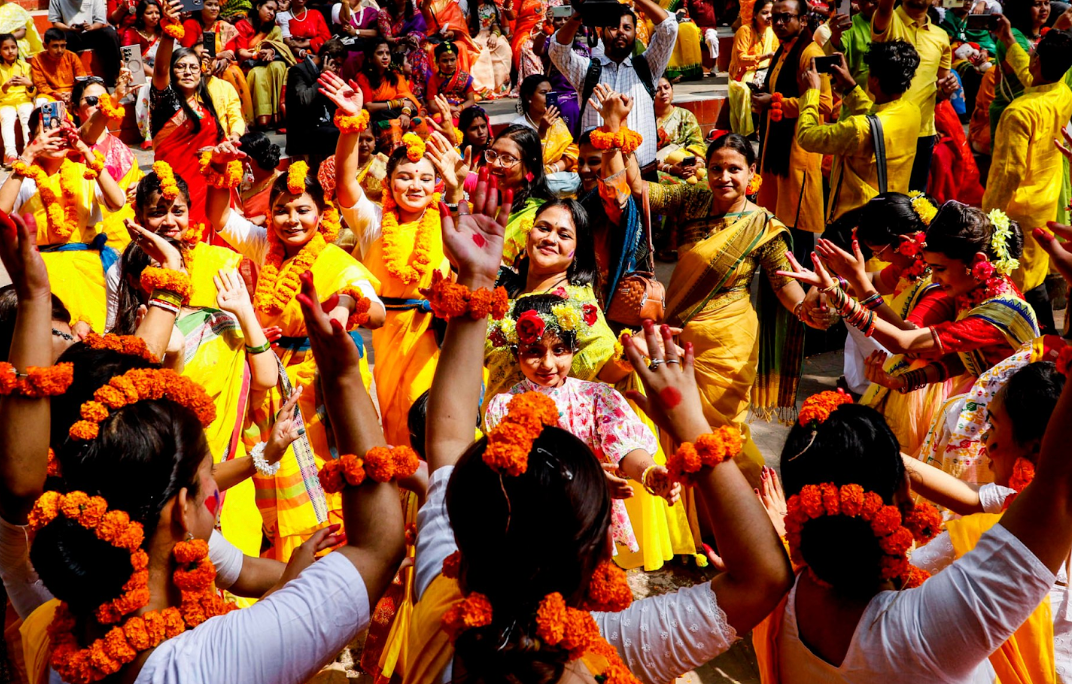
Pohela Falgun is distinguishable by its associated boshonti colours (yellow, orange, and red). Saris, panjabis and kameezes of these colours are sported by men, women, children, and adults alike, often accessorised with flowers, and alpona motifs. Beyond their decorative function, these aesthetic choices also represent a collective shedding of the monotony of winter, and an embrace of warmth and youth, qualities long associated with spring within and beyond Bengali literature and music[1].
For much of recent memory, Pohela Falgun fell on the 13th of February. However, reforms introduced by the Bangla Academy in 2019 adjusted the length of the months to better synchronise with the Gregorian calendar. As a result, Pohela Falgun now officially falls on the 14th of February, coinciding with Valentine's Day, producing a unique spectacle of streets awash with the imagery of both boshonti alpona and love hearts, while providing an alternative celebration of love and life without the commercialised pressure of Valentine's Day[8].
At its heart, Pohela Falgun is about anticipation. Arriving before the full bloom of spring, Pohela Falgun promises renewal even when the air remains cool. As one student puts it, "Pohela Falgun is when colours blend and the essence of love and happiness is recreated"[1].
And if you don't have a Valentine, or if it's still cold where you are, Pohela Falgun offers the reassurance that spring is coming.
References
[1] Islam M. POHELA FALGUN The Harbinger of Colours. The Daily Star. https://www.thedailystar.net/pohela-falgun-the-harbinger-of-colours-10579. Published February 10, 2014.
[2] UNB. Pohela Falgun celebrated across Bangladesh. Dhaka Tribune. https://www.dhakatribune.com/bangladesh/nation/168689/pohela-falgun-celebrated-across-bangladesh. Published February 13, 2019.
[3] Devnath B. Falgun Fest at DU: How it all began. The Daily Star. https://www.thedailystar.net/frontpage/falgun-celebration-how-it-all-began-1360324. Published February 12, 2017.
[4] Bhattacharyya S. "Secular" Distortions of The Syncretic Bengali Calendar. Indiafacts. Published April 18, 2022. https://www.indiafacts.org.in/secular-distortions-of-the-syncretic-bengali-calendar/
[5] Staff Correspondent . Pohela Falgun celebrated. The Daily Star. https://www.thedailystar.net/news-detail-174151. Published February 13, 2011.
[6] Bangladesh Tourism Board. Pahela Falgun. beautifulbangladesh.gov.bd. https://beautifulbangladesh.gov.bd/event/30
[7] Chakraborty Y. A few Bengali calendar basics as we begin 1429. Get Bengal. Published 2022. https://www.getbengal.com/details/a-few-bengali-calendar-basics-as-we-begin-1429
[8] Azran A. Why Pahela Falgun is celebrated on February 14 instead of 13. The Daily Star. https://www.thedailystar.net/culture/news/why-pahela-falgun-celebrated-february-14-instead-13-3542926. Published February 13, 2024.
[9] Khan NH. Celebrating Pohela Falgun. The Daily Star. https://www.thedailystar.net/celebrating-pohela-falgun-63814 . Published February 9, 2015.
[10] Daniyal S. How Akbar invented the modern Bengali calendar. Dhaka Tribune. https://www.dhakatribune.com/opinion/op-ed/18742/how-akbar-invented-the-modern-bengali-calendar. Published April 17, 2017.
Thumbnail: The Daily Star