

Introduction
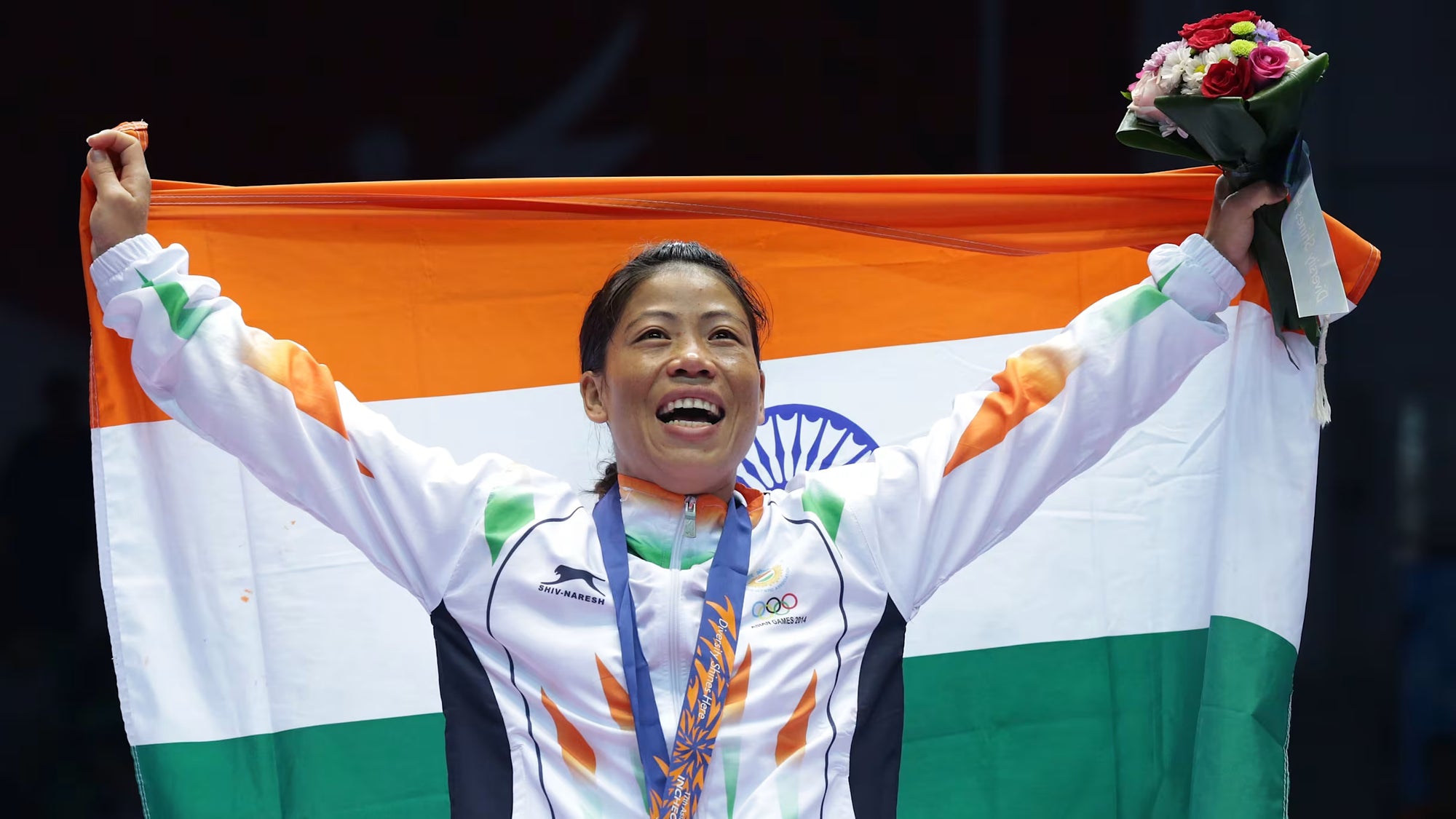
Mary Kom, more aptly described as "Magnificent Mary," stands as an indomitable icon in the world of sports. Hailing from rural Manipur, her story is one of transcending poverty, societal barriers, and personal hardships to become the most successful female boxer in world championship history. As the only woman to win the World Amateur Boxing Championship six times and the only boxer to win a medal in each of the first seven World Championships, Mary Kom's journey is a beacon of perseverance, resilience, and empowerment [1][2].
Early Life and Struggles
Born on November 24, 1982, in Kangathei village, Manipur, Mangtei Chungneijang Kom, now known as Mary Kom, experienced a childhood far removed from luxury. Her early life was defined by the hardships of poverty and demanding farm labor. Her parents, Mangte Tonpa Kom and Mangte Akham Kom, were tenant farmers who struggled to provide for their children. From a young age, Mary contributed to farming chores, which instilled in her a strong work ethic and physical resilience, qualities that would later prove crucial in her boxing career [3].
Inspired by Manipuri boxer Dingko Singh's 1998 Asian Games victory, Mary dreamt of greatness in sports. However, boxing was frowned upon for women in her community, and her father initially opposed her ambitions, fearing for her prospects and safety. This forced her to keep her boxing pursuits a secret during her early training days [4]. She even hid her boxing gloves from her parents. Her boxing ambitions were also criticised because of her short height. Little did everyone know she would go on to become one of the tallest stature in boxing.
Overcoming Barriers: Gender, Poverty, and Societal Norms
Mary Kom's rise was far from straightforward. As a woman in a male-dominated sport, she encountered gender discrimination, with many believing that boxing was only for men. She lacked access to proper equipment and nutrition, often training with makeshift gear due to severe financial constraints [1][3][5]. She also faced additional challenges such as language barriers when she moved to Delhi for advanced training, and regional bias throughout her career, Mary never let these obstacles deter her aspirations [6].
Boxing Career: Achievements and Recognition
Mary Kom began boxing training at age 15 at the Sports Academy in Imphal under coaches K. Kosana Meitei and later M. Narjit Singh. Her determination and hard work quickly bore fruit , she won the Manipur State Women's Boxing Championship in 2000 and soon made her international debut, clinching a silver medal at the world championships in Pennsylvania in 2001. In 2002, she won her first world title, paving the way for a stellar career [1][7].
Major Milestones
-
World Championships: Six-time World Amateur Boxing Champion, the only woman with this achievement [2].
-
Olympics: Bronze medalist at the 2012 London Olympics—the only Indian female boxer to do so [2][8].
-
Asian Games & Commonwealth Games: First Indian woman boxer to win gold at the Asian Games (2014, Incheon) and Commonwealth Games (2018) [2][9].
-
Other Medals: Multiple golds at Asian Championships, Asian Cup, and national tournaments [10].
Her style, rooted in a southpaw stance, focuses on unmatched leads, evasive head movements, and powerful counterattacks, a technical repertoire developed early and honed by years of dedication [11].
National Recognition and Awards
Mary Kom's accolades include the Padma Shri (2006), Padma Bhushan (2013), Padma Vibhushan (2020), Arjuna Award (2003), and Rajiv Gandhi Khel Ratna (2009). The Manipur Government honored her with the title “Meethoi Leima” (“exceptional lady”) and even named a road after her in Imphal [9][12]. She was also nominated to the Rajya Sabha, the upper house of the Indian Parliament by the President of India in 2016 as an exceptional achiever in sports.
![Fig. 1. Mary Kom receiving the Padma Vibhushan. Source: Press Information Bureau / Government of India [18]](https://upload.wikimedia.org/wikipedia/commons/thumb/8/8a/Padma_Vibhushan_Mary_Kom.jpg/1310px-Padma_Vibhushan_Mary_Kom.jpg?20230215022946)
Balancing Motherhood and Athletic Pursuits
One of Mary Kom's defining chapters is her comeback after motherhood. Despite giving birth to twins in 2007 and another son in 2013 (both C-sections), she returned to boxing to win multiple world titles, a feat dismissed by critics as impossible for a woman post-pregnancy [13][14]. She has spoken about the difficulty of balancing the demands of motherhood with the rigors of an international boxing career, highlighting the crucial support of her family and her unyielding determination [15].
Legacy and Impact
Mary Kom's legacy extends far beyond her medals. She has redefined possibilities for women in Indian sports, making boxing accessible and aspirational for a new generation. Through the Mary Kom Regional Boxing Foundation, she nurtures underprivileged youth, especially girls, offering world-class training, education, and holistic support [9][16].
She continues to advocate for gender equality and the development of women's boxing, serving as a mentor and ambassador at national and global forums [17]. The changes her career has inspired are evident in the surge of female participation and investment in women’s boxing in India.
She also raises her voice for India’s North East, the infrastructure issues and the racial discrimation faced by them. She continues to push for greater inclusion of the NorthEast in national narrative. [3]
Conclusion
Mary Kom's journey from the rice fields of Manipur to the summit of world boxing is a powerful testament to the human spirit's ability to triumph over adversity. Her struggles with poverty, societal prejudice, and gender bias only strengthened her resolve. Today, she stands not only as a sporting icon but as a beacon of hope and inspiration for millions, embodying the transformative power of determination, hard work, and resilience [1][3][9].
Note: Some information in this article was assisted by Perplexity AI.
References
[1] “Mary Kom,” Wikipedia. Available: https://en.wikipedia.org/wiki/Mary_Kom
[2] “Mangte Chungneijang Mary Kom,” knowledge.tribal.gov.in, Mar. 27, 2025.
[3] “Mary Kom: The Pride of Manipur – Boxer and Social Activist,” humansofnortheast.com, Apr. 25, 2025.
[4] “Mary Kom, the Boxer and the Woman: Never Say Die!”, mapsofindia.com, Nov. 2018.
[5] “Fighting for India, and Against Prejudice,” The New York Times, Dec. 26, 2014.
[6] “Mary Kom: Motivating Story of India’s Boxing Icon,” hercircle.in, Jan. 2022.
[7] “MARY KOM,” Google Arts & Culture, Sep. 2014.
[8] “India’s Mary Kom makes history at Women’s World Boxing Championships,” oca.asia, Dec. 2024.
[9] “Looking back at Mary Kom’s records and achievements,” firstpost.com, Jan. 2024.
[10] “Mary Kom’s Awards and Achievements,” olympics.com.
[11] “Mary Kom: Southpaw Techniques and Tactics from ‘The Magnificent’,” ramareddy.org, Oct. 2019.
[12] “Mary Kom awarded Padma Vibhushan,” India Today, Jan. 2020.
[13] “Not easy to comeback after getting married and having children: Mary Kom,” India Today, Dec. 2019.
[14] “Supermom: When Mary Kom came back from maternity breaks to clinch multiple medals,” Times Now News, Jul. 2022.
[15] “Balancing motherhood and boxing tough act: Mary Kom,” The Times of India, Jun. 2010.
[16] “Dream Sports Foundation partners with Mary Kom Regional Boxing Foundation,” Dreamsports Group, Jul. 2021.
[17] “India’s star Mary Kom: ‘Gender equality and the development of women’s boxing are so important for the future’,” IBA Sport, Mar. 2021.
[18] Press Information Bureau, Government of India, “The President presenting the Padma Vibhushan to Mary Kom,” Wikimedia Commons, Nov. 8, 2021. [Online]. Available: https://commons.wikimedia.org/wiki/File:Padma_Vibhushan_Mary_Kom.jpg