



Marble, Myth, and Mughal Memory: The Enigma of Lalbagh Fort
Attracting around 3 million visitors a year, in the heart of Old Dhaka lies one of Bangladesh's most iconic historic sites, Lalbagh Fort, or locally known as "Lalbagh Kella" meaning "Red Garden" [1][2]. However, as grand as it is, what remains of the fort is an unfinished construction, with mysteries and myths surrounding its sudden halt [1]. Though riddled with intrigue, the fort demonstrates the region's rich Mughal history and offers people a glimpse of Medieval Bengal [3].
Origins and Abandonment
The construction of the fort began in 1678 under the Mughal Prince, Muhammad Azam Shah, who was the son of the Mughal emperor Aurangzeb [1][4]. Since Dhaka was the provincial capital of the Bengal Subah, the fort was envisioned to act as both a palace and a defensive stronghold along the Buriganga River [3][4]. However, shortly after construction commenced, Azam Shah was recalled to Delhi, likely to support Aurangzeb's Deccan campaigns against the rising Maratha Empire [5][6]. The responsibilities of the project were then transferred to Bengal's governor, Shaista Khan [1][4].
Under Shaista Khan's tenure, the fort's construction was abandoned [1]. According to tradition, his daughter Iran Dukht, commonly referred to as Pari Bibi, died unexpectedly while the fort was still under construction [7]. This incident led to many theories connecting her death to the abandonment of the project. Local lore suggests that the grieving Shaista Khan deemed the site a bad omen and abandoned the project altogether, burying her in a mausoleum in the centre of the fort [1][7]. To this day, the death of Pari Bibi is embedded in Bangladesh's ghost story culture, with recurring folklore describing sightings of her spirit during full moons [8].
![A photograph of inside the tomb of Pari Bibi [15]](https://upload.wikimedia.org/wikipedia/commons/thumb/a/a4/Tomb_of_Pori_Bibi.jpg/1920px-Tomb_of_Pori_Bibi.jpg?_=20190916070318)
Underground tunnels
Beyond the theories regarding its construction, there are further unanswered questions surrounding the complex. One mystery is the presence of underground tunnels below the fort [1]. It is widely believed that during the 1857 uprising against British rule, known as the Indian Rebellion, sepoys attempted to flee through these tunnels and never returned [9]. The legend continues that British investigators sent elephants and dogs into the tunnels and they too disappeared [8]. The tunnels are often described as maze-like defensive passages [1]. Some speculation suggests they connected to Zinzira Fort across the Buriganga River [10], while more extreme folklore claims they extended as far as Delhi. Today, the tunnels remain sealed for safety reasons [1].
Contemporary lore
Another contemporary theory concerns the identity of Pari Bibi, with some suggesting she may have been an Ahom princess, Ramani Gabharu, who converted to Islam after marrying Azam Shah [11][12]. However, this theory remains speculative and is not accepted in mainstream Mughal historiography.
The Architecture
Built along the Buriganga River, the complex is architecturally diverse, comprising a mosque, mausoleum, public audience hall, hammam, gardens, and fortified gates [1][4].
One of the prominent components is the Diwan-i-Aam (Hall of Public Audience), which functioned as the administrative heart of the complex where the Mughal governor conducted state affairs [4][13]. Attached to it is a Turco-Persian-style hammam reserved for Mughal elites. The hammam underwent a $185,000 restoration funded by the U.S. Ambassadors Fund for Cultural Preservation (AFCP) [14]. The bathhouse features an underground heating system and advanced drainage mechanisms, demonstrating Mughal engineering sophistication [4][13].
The architectural centerpiece of the complex is the mausoleum dedicated to Pari Bibi. Centrally positioned within landscaped gardens, the tomb is constructed of marble and black basalt and crowned with a single dome [1][4]. The surrounding gardens reflect the charbagh design tradition — a Persian quadrilateral layout symbolising paradise in Mughal-Islamic architectural philosophy [13].
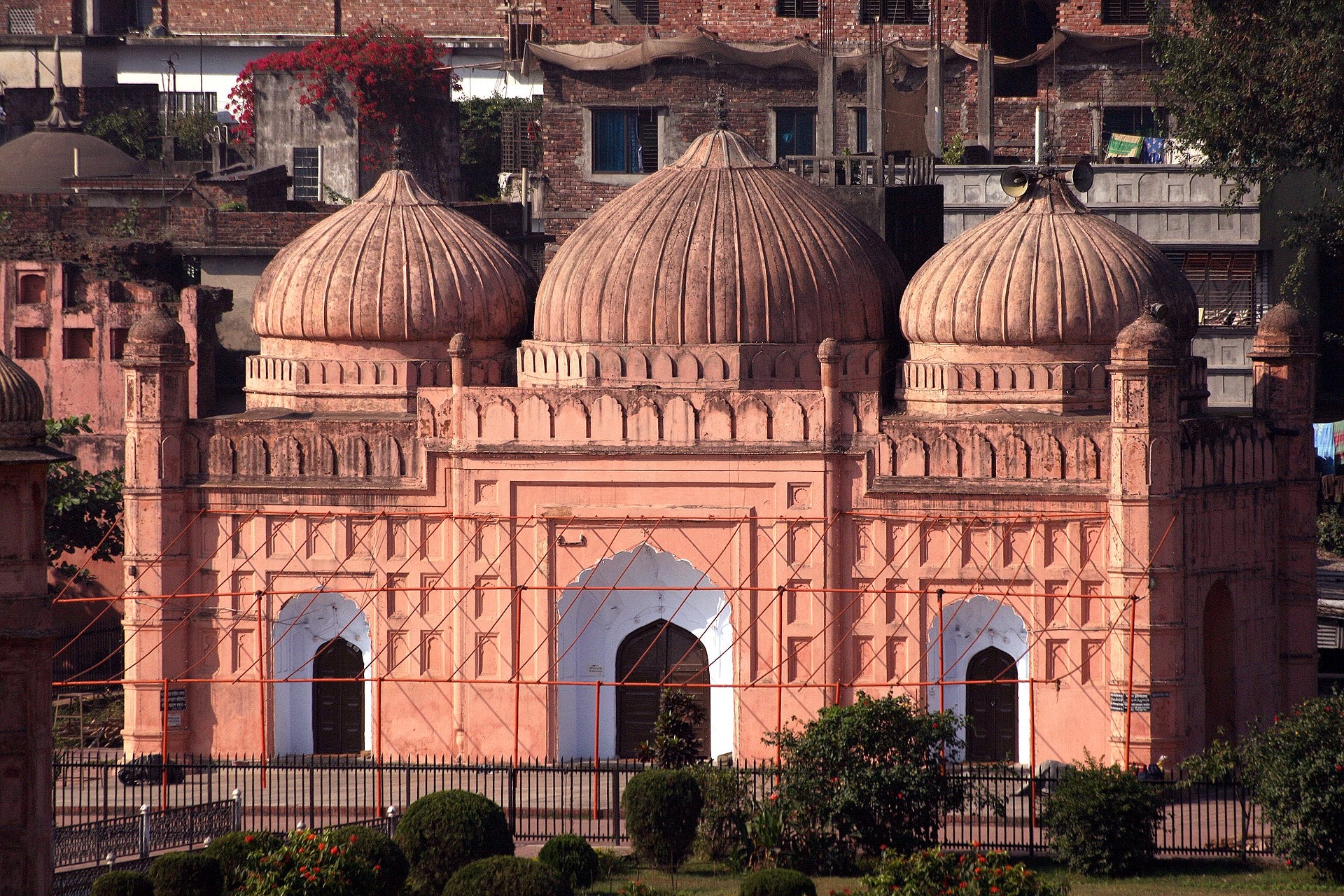
To the west stands the three-domed Lalbagh Mosque, built in typical Mughal provincial style and still in use today [1]. The mosque is enclosed by fortified walls and gates, some of which remain incomplete, reinforcing the narrative of an abandoned imperial vision [1][4].
![A photograph of the dedicated mausoleum to Pari Bibi and the surrounding gardens [17]](https://www.historyhit.com/app/uploads/bis-images/5154647/Lalbagh-Fort-Shutterstock-1576x1074.jpg)
Conclusion
Ultimately, Lalbagh Fort's enduring fascination lies not only in what was built, but in what was left unfinished. Whether halted by personal tragedy, shifting imperial priorities under Aurangzeb, or later mythologised through folklore, the fort represents a transitional moment in Mughal Bengal.
References
[1] Banglapedia, "Lalbagh Fort," Asiatic Society of Bangladesh. [Online]. Available: http://en.banglapedia.org/index.php/Lalbagh_Fort
[2] UNESCO World Heritage Centre, "Lalbagh Fort (Tentative List)," 1999. [Online]. Available: https://whc.unesco.org/en/tentativelists/1197/
[3] R. M. Eaton, The Rise of Islam and the Bengal Frontier, 1204–1760. Berkeley: University of California Press, 1993. [Online]. Available: https://publishing.cdlib.org/ucpressebooks/view?docId=ft067n99v9
[4] N. Ahmed, Lalbagh Fort. Dhaka: Asiatic Society of Bangladesh, 1968.
[5] J. F. Richards, The Mughal Empire. Cambridge: Cambridge University Press, 1993.
[6] S. Gordon, The Marathas 1600–1818. Cambridge: Cambridge University Press, 1993.
[7] Banglapedia, "Pari Bibi." [Online]. Available: http://en.banglapedia.org/index.php/Pari_Bibi
[8] The Daily Star, "Haunted Dhaka: Tales from Lalbagh Fort." [Online]. Available: https://www.thedailystar.net
[9] W. Dalrymple, The Last Mughal: The Fall of a Dynasty, Delhi, 1857. New York: Knopf, 2006.
[10] Banglapedia, "Zinzira Palace." [Online]. Available: http://en.banglapedia.org/index.php/Zinzira_Palace
[11] E. Gait, A History of Assam. Calcutta: Thacker, Spink & Co., 1906.
[12] S. L. Barua, A Comprehensive History of Assam. New Delhi: Munshiram Manoharlal, 1985.
[13] E. Koch, Mughal Architecture: An Outline of Its History and Development. Munich: Prestel, 1991.
[14] U.S. Embassy in Bangladesh, "Ambassadors Fund for Cultural Preservation Supports Lalbagh Fort Restoration." [Online]. Available: https://bd.usembassy.gov
[15] Wikimedia Commons, "Tomb of Pori Bibi, Lalbagh Fort." [Online]. Available: https://commons.wikimedia.org/wiki/File:Tomb_of_Pori_Bibi.jpg
[16] Archnet, "Lalbagh Fort – Architecture and Details." Archnet Digital Library. [Online]. Available: https://www.archnet.org/sites/3055?media_content_id=3762
[17] HistoryHit, "Lalbagh Fort — Location & History." HistoryHit. [Online]. Available: https://www.historyhit.com/locations/lalbagh-fort/
[18] Wikimedia Commons, "Lalbagh Mosque (DG_40_–_0_8)." [Online]. Available: https://commons.wikimedia.org/wiki/File:DG_40_-_0_8_LAL_BAG_PORT_MOSQUE_1678_-_79_DHAKA