

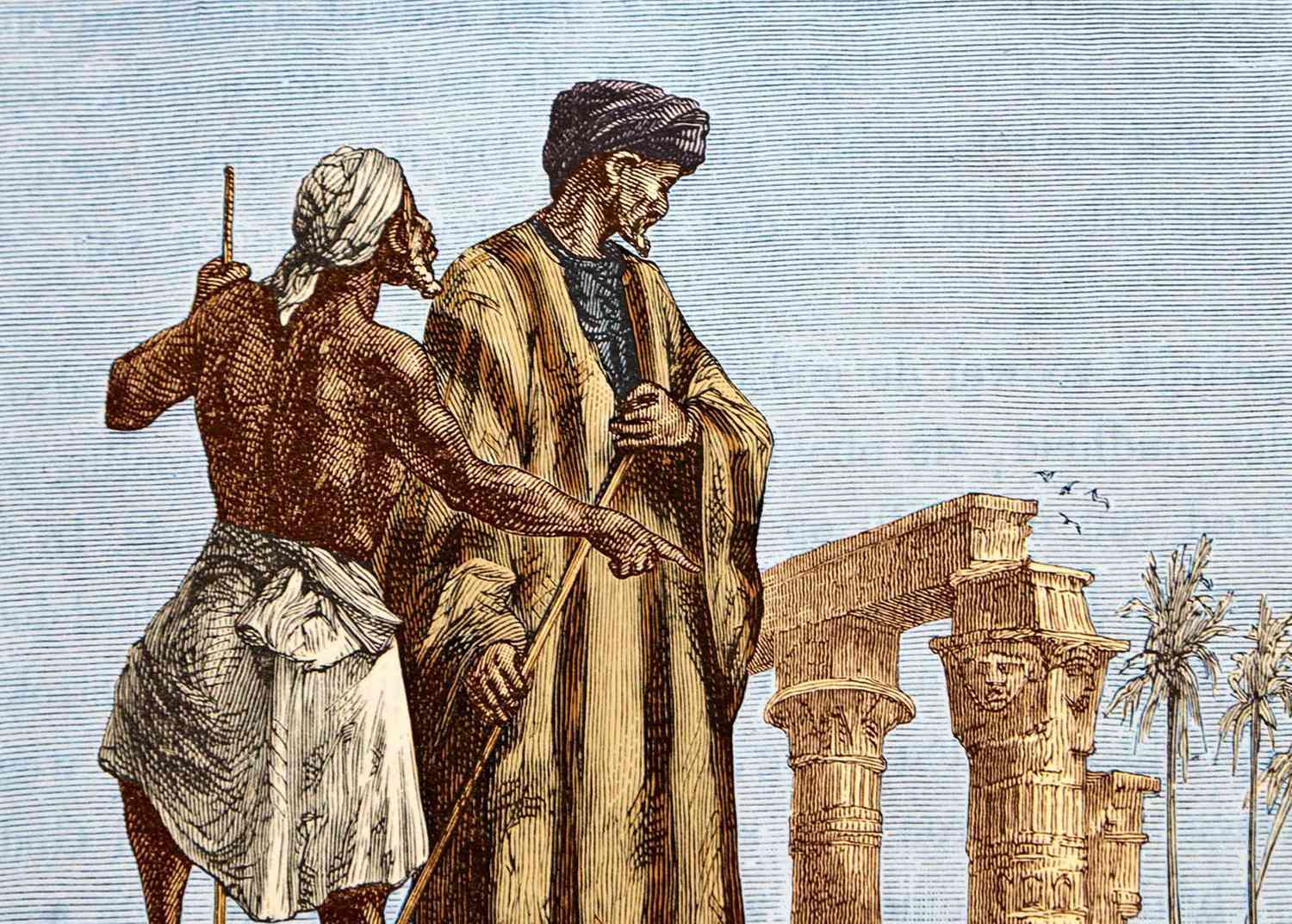
Ibn Battuta (1304-1369) was the most widely travelled explorer of the pre-modern world. Almost all that is known about his life comes from his own travel account. He left Morocco at age 21 to perform Hajj and did not return for 24 years. After spending eight years in India under the employment of the Sultan of Delhi, Ibn Battuta was sent on a diplomatic mission to China. Although a shipwreck threw off this expedition to China, Ibn Battuta continued towards China. It was on this journey that he visited Bengal.
Ibn Battuta visited Bengal in July and August 1346, primarily to meet the renowned Sufi saint Shah Jalal in Kamrupa/Sylhet. He first arrived at Sudkawan (thought to be modern-day Chittagong) on 9 July 1346. He then undertook a month-long journey to the mountains of Kamrupa to meet Shah Jalal, staying three days at his hospice. Afterwards, he travelled by river for 15 days through densely settled villages and orchards to Sonargaon, departing on 14 August 1346 for Java. His entire stay in Bengal lasted less than two months.[1]
'It is a hell full of blessings'
Battuta's account provides the earliest detailed outsider description of Bengal's society. He described Bengal as a vast and spacious land with abundant rice and the cheapest goods he had seen anywhere. He noted detailed prices of daily commodities, highlighting economic prosperity and food abundance. Some examples translated to modern currencies include: 11 paisa per maund of rice, 71 paisa per maund of sesame oil, and three taka for a buffalo.[2] He also described lively river trade, crowded with ships that greeted one another by beating drums. He quotes the people of Khurasan saying, 'it is a hell full of blessings'.[3]
'I have seen a slave-girl, good looking and suited to be a concubine, sold for a single gold dinar'
While in Bengal, Ibn Battuta and his companion purchased an enslaved person each: a young boy and a young girl. Medieval Bengal, as part of North India, contained forms of servile labour. The obligations of those engaged in servitude went far beyond agricultural labour, encompassing a wide and undefined range of services necessary for sustaining elite households and estates. Simultaneously, North Indian regions made use of 'elite' slaves, such as military slaves, concubines, and eunuchs, who could enjoy wealth, power, and privilege.[4]
Masters could sell, gift, or inherit slaves, and slaves could not own property independently. However, slavery was not necessarily permanent, as slaves could marry, earn income, and even purchase freedom with the master's consent. Slaves came from war captives, raids into non-Muslim territories, and hereditary slavery. Over time, concern for 'rightful enslavement' declined, and slaves were increasingly obtained through trade, tribute, and markets.
By the fourteenth century, rising demand led to an increase in the procurement of slaves from outside India, generating profitable cross-border trade. Bengal became known for the cheap sale of slaves, establishing itself as central to an organised slave trade network.
The trafficking of eunuchs was highly specialised and lucrative, for which Sylhet emerged as a centre. Eunuchs were not sold openly but supplied directly to royal and aristocratic patrons and exported to distant courts. They occupied trusted positions as court officials, harem guardians, managers, and attendants, symbolising imperial splendour. Slave trading persisted into Mughal times, especially in Bengal, where networks involving Magh pirates and Portuguese intermediaries were established, and was not abolished in the subcontinent until the Indian Slavery Act of 1843.[5]
'They are famous for resorting to magic and for their involvement in it'
Battuta noted that the people who lived in the mountains of Kamrupa were reputed for magic and witchcraft, a theme linked to legends about Shah Jalal overcoming local sorcerers. It is now believed that the catfish at the shrine to Shah Jalal are these defeated magicians.
Madhu Khanna writes that Bengal and Assam were 'an unrivalled centre of tantric culture and the original home of a special variety of a hybrid and multicultural tradition of Tantra in Eastern India'.[6] This 'special variety' of Tantra was informed by the variety of religions being practised simultaneously during and before the 14th century.
'Sultan Fakhr al-Din, surnamed Fakhra, an excellent Sultan, a lover of strangers and especially of faqirs and sufis'
The Sultan of Delhi to whom Ibn Battuta reported for eight years, Muhammad Tughluq, lost control of East Bengal in 1338. Sultan Fakhr al-Din Mubarak Shah then claimed this kingdom for himself. Two years later, West Bengal also broke away from the Delhi Sultanate.
Ibn Battuta praised Sultan Fakhr al-Din Mubarak Shah as a just ruler, who was hospitable to foreigners and shared Battuta's love of faqirs and Sufis. Ibn Battuta recounts a balanced and detailed account of Bengal's political conflicts, including the Sultan's struggles with Ali Shah of Lakhnauti, demonstrating impartiality despite serving as an envoy of the Delhi Sultan. However, he did not visit Sultan Fakhr al-Din, presumably due to his own political affiliations.
'Among the greatest saints and most remarkable men, responsible for famous miracles and wonderful achievements'
Ibn Battuta was deeply devoted to saints throughout his travels and increasingly inclined toward asceticism and spiritual discipline. Before travelling to South Asia, Battuta visited Egypt, where the famous saint Shaykh Abu Abdallah al Murshidi foretold of his travels to come.[7] Ibn Battuta himself took up a lifestyle of asceticism, prayer and discipline, before being swayed by Muhammad Tughluq's invitations to a diplomatic trip to China.
Ibn Battuta regarded Shah Jalal as one of the greatest saints of his age, famed for miracles, foreknowledge, and longevity (said to live 150 years). He recounts that Shah Jalal fasted for forty years, breaking the fast only after ten continuous days. Shah Jalal participated in the conversion of Buddhists and Hindus in Sylhet to Islam, a movement that later spread throughout Bengal.[8] On describing the hospice of Shah Jalal, Ibn Battuta writes that the land was uncultivated, and that both Muslims and non-Muslims would travel to the hospice with gifts for the Sufi Saint.
References
[1] Gibb; Beckingham (1994)
[2] https://en.banglapedia.org/index.php/Ibn_Battuta
[3] Gibb; Beckingham (1994)
[4] Bano (2024)
[5] ibid
[6] Khanna (2023)
[7] Metcalf (2018)
[8] Dunn (2005)
Thumbnail: https://www.thoughtco.com/ibn-battuta-biography-travels-4172920