




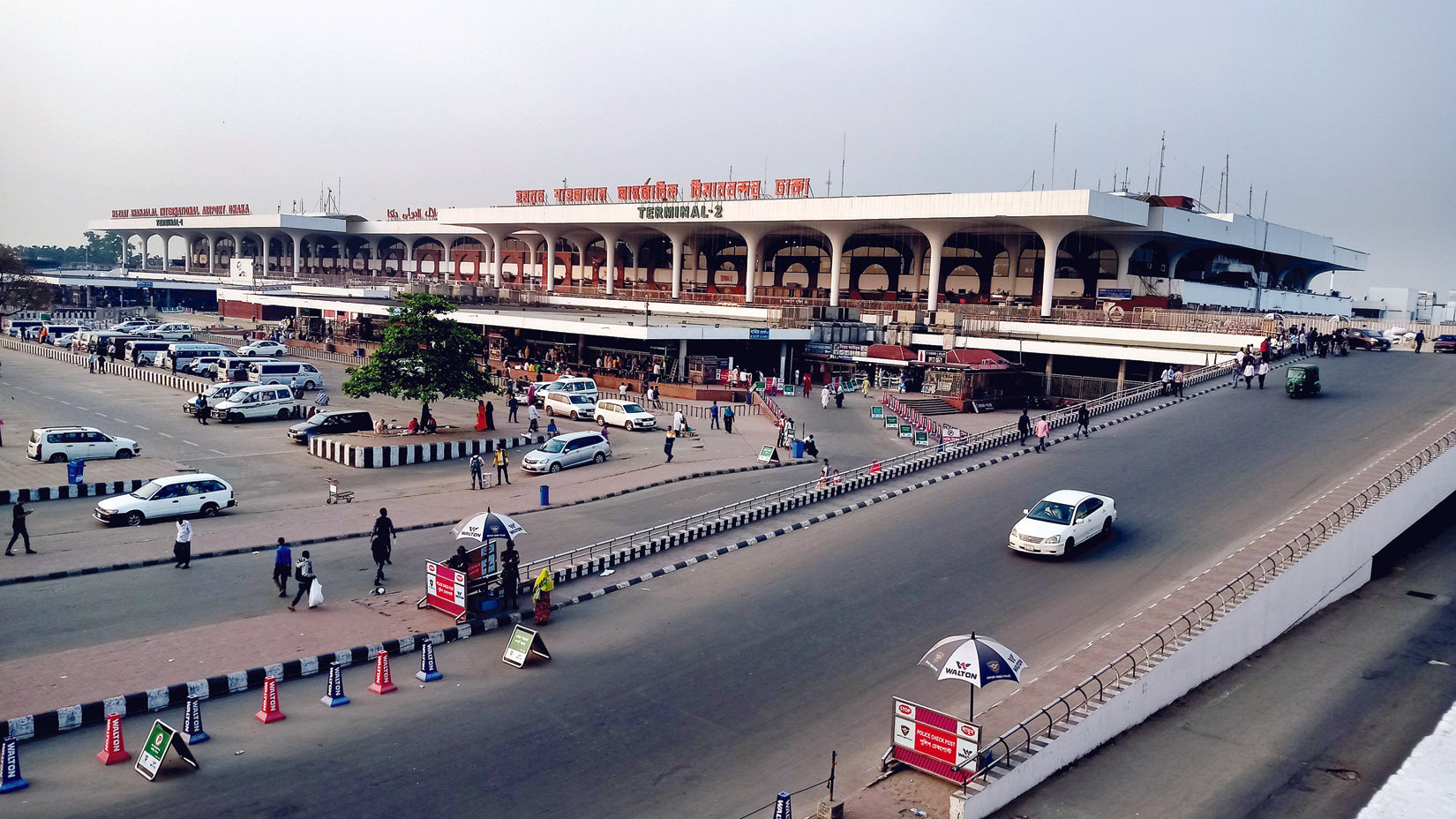
Handling over 20 million passengers annually, Hazrat Shahjalal International Airport (HSIA) is Bangladesh’s main international gateway, connecting it to regions across Asia, the Middle East, Europe, and North America[1]. Located just 18 km north of downtown Dhaka in Kurmitola, HSIA is historic as the first international airport of independent Bangladesh.
The airport was first proposed before Bangladesh’s independence, after the destruction of Tejgaon Airport in then-East Pakistan during the 1965 Indo-Pakistani War. The Pakistani government called for the construction of a new terminal, runway, and railway in Kurmitola, with technical assistance from French experts. However, during the 1971 Liberation War, the incomplete facility sustained damage that delayed completion until 1980, when it was finally inaugurated [1].
![Figure 1. Hazrat Shahjalal International Airport, Dhaka — Bangladesh’s main international gateway [11]](https://gyazo.com/cdb357fa4495ddf37d48576306ab9298.png)
Naming History
The airport began operations in 1980 under the name Dacca International Airport, inaugurated by President Ziaur Rahman [1]. After his assassination in 1981, it was renamed Zia International Airport by President Abdus Sattar to honor the late leader [1].
Nearly three decades later, in 2010, the name changed again: the government renamed the facility Hazrat Shahjalal International Airport in honor of the Sufi saint Hazrat Shah Jalal [2][3][4]. The decision sparked some controversy, with critics arguing that the change was politically motivated due to Ziaur Rahman’s historical association with the opposition party of the ruling Awami League [2][3][4]. A representative of the Civil Aviation Authority, however, maintained that naming public institutions after revered Sufi figures was a longstanding national tradition and that this renaming reflected Bangladesh’s spiritual heritage.
Biographical Traditions and Scholarly Perspectives
Hazrat Shah Jalal is one of Bengal’s most venerated Sufi saints, remembered through hagiographic texts, folklore, and oral traditions. Particularly revered in Sylhet, he is regarded as a pioneer who helped spread Islam across the region.
Though popularly known simply as Hazrat Shah Jalal, an inscription dated 1503 records his full name as Shah Jalal Mujarrad Kunya’i, the title “Hazrat” later added to reflect his piety and “Mujarrad” signifying his celibate life [5]. His story follows a familiar motif in South Asian Sufism: ascetic mystics traveling eastward to preach Islam through spiritual example rather than conquest.
The life of Shah Jalal, while only compiled in writing centuries after his time, remains a powerful regional narrative that plays a crucial role in the identity and pride among both Sylhetis and the Bangladeshis around the world.
Legends and Historical Traditions
Origins and the Soil Prophecy
According to long-held tradition, Shah Jalal’s journey to Bengal began when his spiritual guide gave him a handful of soil and instructed him to travel east until he found land with matching earth which was implied to be the divinely destined place for his mission [5]. His travels reportedly took him through Yemen, Baghdad, Delhi, and Punjab, accompanied by hundreds of disciples.
Accounts vary in regards to his disciples: some claim he had 313 companions, mirroring the Prophet Muhammad’s followers at Badr, while others speak of 360. However, it is commonly believed these companions eventually dispersed throughout the region to settle and teach Islam [5]. Many of these figures are locally venerated today, their shrines dotting Sylhet and beyond.
Conquest of Sylhet
One of the most enduring legends connects Shah Jalal to the Conquest of Sylhet. As narrated in Gulzar-i-Abrar (17th century), a hagiographical work documenting the lives of saints in India, the local ruler Gour Govinda executed a Muslim child whose father had sacrificed a cow during an aqiqah ceremony. In response, Muslim leaders Syed Nasiruddin and Sikandar Khan Ghazi led an expedition against him [6]. Following their victory, Shah Jalal entered Sylhet, where he established his khanqah (spiritual lodge and learning center).
Upon arrival, he found the soil identical to the handful his mentor had once given him, symbolizing the fulfillment of his destiny [6]. For locals, this story represents both divine destiny and the peaceful rooting of Islamic spirituality in Bengal.
Ibn Battuta’s Encounter
The most vivid early reference to Shah Jalal (or a saint identified with him) appears in the travelogue of the Moroccan explorer Ibn Battuta, who visited Sylhet around 1345. In The Rihla, Ibn Battuta writes:
“We went on to the country of Bengal, where I met the venerable Shaikh Jalal ad-Din. He was a great ascetic and saintly man… his food consisted only of the milk of a goat which he kept by him.” [7]
Ibn Battuta continues, describing the saint’s tall stature, pale complexion, and simple lifestyle, noting that his disciples hailed from diverse lands and that many travelers spoke of his miracles and wisdom [7]. He also records that he later received news of the saint’s death in 1346 [7].
While scholars debate whether Ibn Battuta’s “Shaikh Jalal ad-Din” refers specifically to Shah Jalal of Sylhet or to another Sufi such as Jalal al-Din Tabrizi [8], the thematic parallels of asceticism, foreign disciples, and miraculous renown resonates strongly with Sylheti tradition.
These early accounts, viewed alongside regional lore, help position Shah Jalal within the broader cultural memory of 14th-century Bengal as a figure embodying humility and divine inspiration.
Legacy and Symbolism
Though the factual boundaries of his biography remain blurred, Shah Jalal’s spiritual impact on Bengal is undeniable. His dargah in Sylhet continues to attract pilgrims from across Bangladesh and abroad, serving as a symbol of unity between local faith and global Sufi tradition.
Historian Richard M. Eaton’s The Rise of Islam and the Bengal Frontier, 1204–1760 highlights how Islam’s expansion in Bengal occurred not primarily through conquest but via agrarian settlement and the spiritual networks of Sufi saints [9]. Figures like Shah Jalal, Shah Makhdum Ruposh of Rajshahi, and Khan Jahan Ali of Khulna played pivotal roles as moral authorities and community organizers [9][10].
Eaton’s framework shows that conversion in Bengal was a gradual social process. It was one of integration and cultural adaptation where Sufi shrines functioned as hubs of mediation between new Muslim settlers and indigenous communities [9]. Later research by Halim (2022) reinforces this view, describing how Sufi orders maintained social cohesion and continuity through the Mughal period [10].
Within this wider Sufi mosaic, Shah Jalal stands out as a symbol of both devotion and national identity. His story unites legend, faith, and history into one narrative that continues to shape how Bangladesh views its past. The 2010 renaming of Dhaka’s airport after him therefore carries more than ceremonial weight as it reaffirms the connection between modern Bangladesh and its spiritual roots [2][4].
As Eaton notes, Bengal’s Islam was never monolithic but evolved through countless intermediaries, local saints, and shared practices [9]. Naming the country’s largest airport after Shah Jalal thus pays tribute to the enduring legacy of these mystics who helped weave spirituality into the region’s cultural fabric.
![Figure 2. Hazrat Shah Jalal Dargah in Sylhet — one of the country’s most visited pilgrimage sites.[12]](https://www.nextgobd.com/media/postImage/Shahjalal-Mazar-Dargah-Shahjalal-Sylhet.jpg)
References
Business Recorder; “Bangladesh to Rename Airport,” Feb. 16, 2010.
CAAB (Civil Aviation Authority of Bangladesh); “About HSIA” and “History of HSIA,” n.d.
Eaton, R. M.; The Rise of Islam and the Bengal Frontier, 1204–1760, University of California Press, 1993/2000.
Eaton, R. M.; “Shrines, Cultivators, and Muslim ‘Conversion’ in Punjab and Bengal, 1300–1700,” The Medieval History Journal, vol. 12, pp. 191–220, 2009.
Fuad, A. R.; “The Contribution of Shah Jalal in the Context of Bengal Islamization,” İSTEM, vol. 39, pp. 95–114, 2022.
Halim, W.; “The Sufi Sheikhs and their Socio-cultural Roles in the Islamization of Bengal During the Mughal Period (1526–1858),” Journal of Islamic Civilization in Southeast Asia (JICSA), 2022.
Indian Express; “Bangladesh Renames Airport After Sufi Saint,” Feb. 16, 2010.
Ibn Battuta; The Rihla (Travels), c. 1355, trans. H. A. R. Gibb, Cambridge University Press, 1962.
Porzoton; “Hazrat Shah Jalal Mazar, Sylhet,” https://porzoton.com/hazrat-shahjalal-mazar-sylhet/
(accessed Oct. 17, 2025).
The Daily Star; “HSIA Renaming Decision Draws Mixed Reactions,” Feb. 2010.
“Hazrat Shahjalal International Airport, Dhaka,” Civil Aviation Authority of Bangladesh, https://caab.portal.gov.bd/
(accessed Oct. 17, 2025).
[1] CAAB (Civil Aviation Authority of Bangladesh), “About HSIA” and “History of HSIA,” n.d.
[2] Business Recorder, “Bangladesh to Rename Airport,” Feb. 16, 2010.
[3] The Daily Star, “HSIA Renaming Decision Draws Mixed Reactions,” Feb. 2010.
[4] Indian Express, “Bangladesh Renames Airport After Sufi Saint,” Feb. 16, 2010.
[5] A. R. Fuad, “The Contribution of Shah Jalal in the Context of Bengal Islamization,” İSTEM, vol. 39, pp. 95–114, 2022.
[6] A. R. Fuad, ibid.
[7] Ibn Battuta, The Rihla (Travels), c. 1355, trans. H. A. R. Gibb, Cambridge University Press, 1962.
[8] R. M. Eaton, The Rise of Islam and the Bengal Frontier, 1204–1760, Univ. of California Press, 1993/2000.
[9] R. M. Eaton, “Shrines, Cultivators, and Muslim ‘Conversion’ in Punjab and Bengal, 1300–1700,” The Medieval History Journal, vol. 12, pp. 191–220, 2009.
[10] W. Halim, “The Sufi Sheikhs and their Socio-cultural Roles in the Islamization of Bengal During the Mughal Period (1526–1858),” Journal of Islamic Civilization in Southeast Asia (JICSA), 2022.
[11] “Hazrat Shahjalal International Airport, Dhaka,” Civil Aviation Authority of Bangladesh, https://caab.portal.gov.bd/ (accessed Oct. 17, 2025).
[12] “Hazrat Shah Jalal Mazar, Sylhet,” Porzoton, https://porzoton.com/hazrat-shahjalal-mazar-sylhet/ (accessed Oct. 17, 2025).