




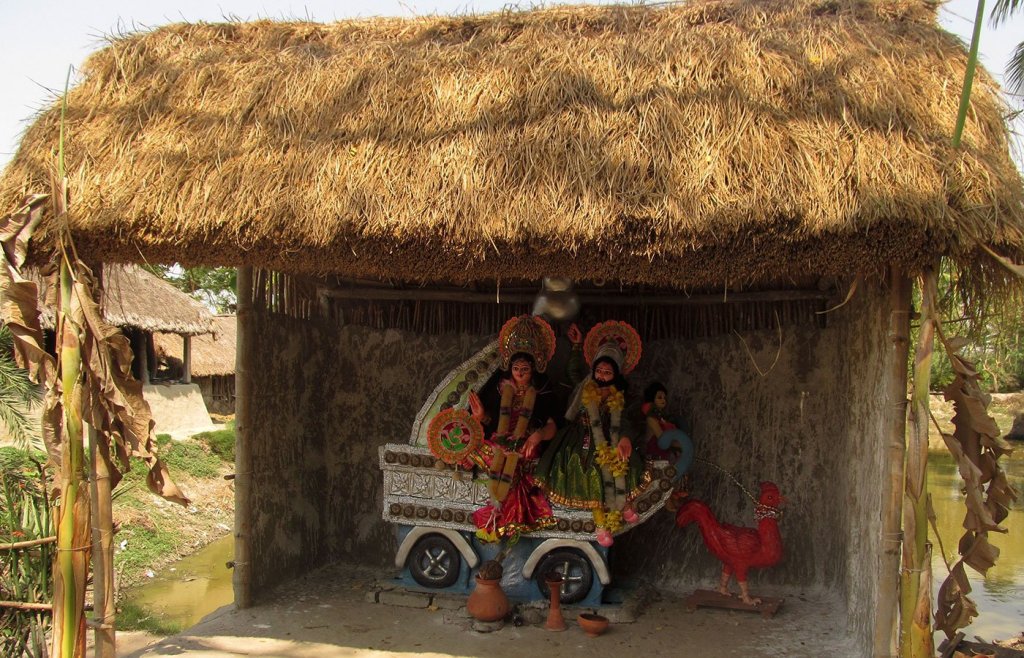
Origins and Mythology of Bonbibi
Bonbibi, also known as Bonodebi or Ma Bonbibi, is a forest goddess venerated across the Sundarbans by both Hindus and Muslims. Her story is primarily told in the Jahuranama, which blends Islamic and Bengali folk motifs, featuring Islamic characters such as Fatima and Muhammad, alongside Bengali names like Phulbibi. The Jahuranama is written in a mixture of Arabic, Persian and Bengali, and although it is written in the Bengali Hindu meter payar chhanda, it reads from back to front as with Arabic texts.[1]
According to the Jahuranama, Berahim Fakir lived in Mecca and was married to a woman named Phulbibi who could not conceive a child. After consulting with his daughter Fatima, the prophet revealed that Berahim would have two children if he took a second wife. Phulbibi agreed to her husband taking a second wife on the condition that Berahim eventually fulfil a promise to her. When Berahim’s second wife, Golabibi, became pregnant, Phulbibi grew jealous and used her promise to banish Golabibi into the forest, where she gave birth to Bonbibi and Shah Jangali. Unable to care for both children, Golabibi abandoned Bonbibi to be raised by deer, establishing the connection between Bonbibi and nature. In adulthood, Bonbibi was reunited with her brother, together with whom she went on to defeat Narayani, mother of the Hindu tiger god Dakshin Ray.[2] However, Bonbibi was merciful and allowed Dakshin Ray to retain a share of the Sundarbans, emphasising themes of balance and coexistence.
In the above tale, Muhammad, Fatima and Allah intervene in the affairs of the Sundarbans, demonstrating that God is present in Bengal, and legitimising Bonbibi as an authoritative power. Much like the saints who are venerated in shrines throughout Bengal, such as Khan Jahan Ali, Bonbibi was given a divine charge to travel from the Middle East to Bengal. Thus, the story of Bonbibi can be traced back to the rise of Islam in Bengal during the 13th century.[3] Although the Jahuranama was written by Khater in the late nineteenth century, the oral tradition significantly predates the written version, and accounts from the early British period describe the veneration of Bonbibi.[4] While the Jahuranama draws on both Islam and Hinduism, Bonbibi’s domain is restricted to the Sundarbans, and she has no role in worldviews such as Muslim salvation and Hindu rebirth.
In a second tale of importance, Bonbibi rescues the poor boy Dukkhe from being sacrificed, establishing her role as protector of the pure of heart and the marginalised. Dhona, a wealthy man who traded honey and wax, took Dukkhe, a poor man who lived with his elderly mother, into the forest on the promise that the trip would bring him wealth, but Dukkhe’s mother feared for her sons safety and advised him to call on Bonbibi if he needed rescuing. After neglecting to perform puja to Daksin Ray, Dhona offered Dukkhe as a sacrifice to the tiger god, who was set to devour him in tiger form. Dukkhe called out to Bonbibi, who saved Dukkhe and rewarded him for his piety.

Syncretic Worship and Rituals
Bonbibi’s worship transcends religious boundaries. Her shrines are simple, doorless, and open to all, at which Muslims offer duwa and Hindus perform puja - although Muslim followers of Bonbibi often prepare to offer duwa and tie a red cloth to a flagstaff or tree on the edges of the forest.[5] Smaller thans and homemade altars exist at forest edges and villages, indicating a coexisting practice of private worship. Rituals include offerings of sweets, khichuri, or chicken, tying red scarves to boats, and invoking Bonbibi through tiger charmers (gunin/bawali) who must be pure of heart.[6] Those whose livelihoods depend on the Sundarbans worship other deities, such as Kalu Roy, the crocodile god, and Manasa, the serpent goddess.[7]
Bonbibi is depicted variably: in a sari in Hindu regions or a salwar kameez in Muslim-majority ones, often riding a tiger, holding a fish or cockerel, and accompanied by her brother. The production of Bonbibi sculptures for shrines can be an artisan family business, with sculptures being replaced or renewed before key festivals. These icons are woven using straw, coated in clay, and painted.[8] Annual festivals, especially on Makar Sankranti (Poush month), involve recitations of the Jahuranama and performances of Dukkher Jatr.[9] These festivals serve to bring communities together and reaffirm their connection with their environment. They also reflect a need for balance between consistency and change, particularly poignant in the face of the changing environment of the Sundarbans.
The Sundarbans
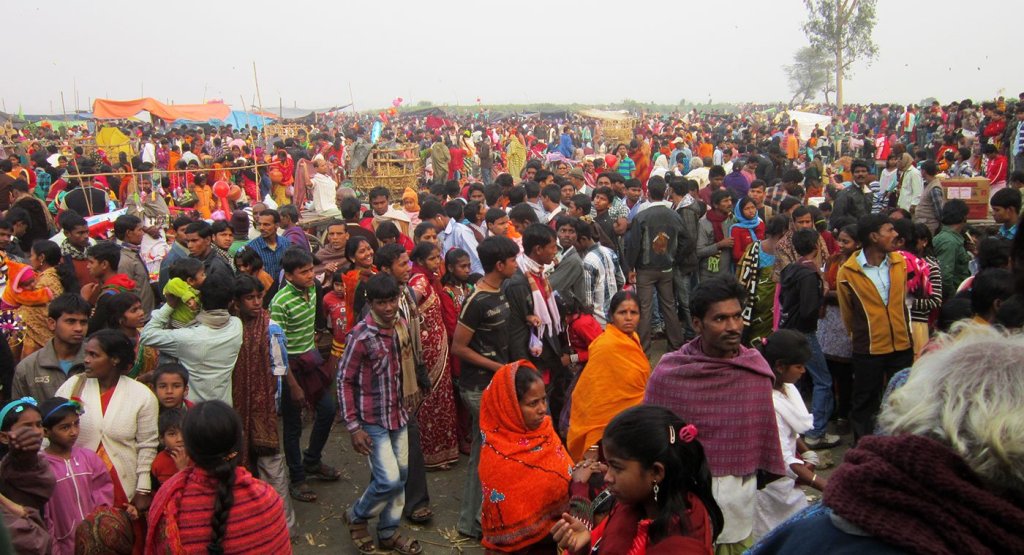
The Sundarbans, spanning India and Bangladesh, is the world’s largest mangrove forest, formed at the Ganga–Brahmaputra–Meghna delta. The forest, whose name means ‘beautiful forest’ in Bangla, acts as an essential ecosystem which protects inland areas such as Kolkata and Dhaka from sea water intrusion and extreme climate. It spans ten thousand square miles, and is home to 7.5 million people in Bangladesh and 4.5 million people in West Bengal.[10] Of the 4.5 million in Bangladesh, approximately one quarter are dependent on the forest for their livelihoods, with some working as woodcutters, shrimp farmers, crab-collectors and honey gatherers.[11] Most of this work is seasonal and climate-dependent, and such work is typical of economically disadvantaged, landless people.
The forest is also home to endangered species such as the Royal Bengal tiger and the giant Asian honeybee. Therefore, the worship of Bonbibi encodes ecological rules: only those who are pobitro mon (pure of heart) and khali hate (empty-handed) may enter, as per the promise made by Dukkhe when Bonbibi saves him. Those who rely on the forest for their livelihoods (such as honey gatherers, crab collectors, shrimp farmers, and woodcutters) are protected by Bonbibi as long as they do so without greed. The core forest area remains largely untouched due to the belief that it was granted to Dakshin Ray by Bonbibi, indirectly aiding biodiversity conservation.[12]

The Future of Bonbibi: Climate Change and Modernity
Climate change has intensified cyclones, salinity intrusion, land loss, and deforestation, disrupting wildlife, agriculture, and traditional livelihoods. As the sea level rises, the salinity of the water increases, threatening the current ecosystem, which relies on freshwater.[13] Simultaneously, increasing areas of the Sundarbans are seen as protected reserves, leaving less and less of it available for aquaculture.[14]
Residents of the Sundarbans demonstrate through their respect for Bonbibi a respect for nonhuman entities and their rights to the space. Bonbibi did not expel Dakshin Ray from the forest, and so too the people of the Sundarbans must respect the right that the Bengal tiger has to be there. The Bengal Tiger is the reason that the forest still spans such an expanse, since the British failed to claim the land for cultivation due to the threats that the wildlife posed.[15]
Although Bonbibi’s legend teaches the importance of sharing forest resources with the tigers, factors such as land loss and deforestation are also leading to an increasingly strained relationship between tigers and humans. Tiger widows, some of whose husbands were killed while foraging illegally in restricted zones, face social stigma, PTSD, and minimal compensation.[16] Many have also lost family members to attacks by sharks and crocodiles while engaging in livelihood activities.
While modernisation, the growing tourism industry, and alternative employment opportunities have reduced these communities’ dependence on the forest, many remain steadfast in their devotion to Bonbibi.[17] However, her syncretic identity faces pressure, as some seek to redefine her as purely Hindu or to reject her as un-Islamic.[18]
Bonbibi reinforces principles of sustainability, equality, and humility, promoting respect for both human and nonhuman life. Reverence for Bonbibi reflects reverence for the ecosystem itself; she represents the living bond between humans, tigers, and mangroves. Her mythology, rituals, and ethics continue to serve as a cultural framework for resilience amidst environmental and social change in the Sundarbans.
References
[1] Vimal (2021)
[2] Note that Dakshin Ray is described very differently in the Raymanjyal, an epic poem that celebrates him as a benevolent protector of people.
[3] Some scholars think the Sundarbans were inhabited as far back as the 8th century CE, and most agree that fishermen and woodcutters inhabited the region by the 18th century CE.
[4] Uddin (2019)
[5] Uddin (2019)
[6] Black; Rose (2025)
[7] Mandal; Halder (2023)
[8] Black; Rose (2025)
[9] Uddin (2019)
[10] Uddin (2019)
[11] Black; Rose (2025)
[12] Mandal; Halder (2023)
[13] Mandal; Halder (2023)
[14] Ghosh (2018)
[15] Uddin (2019)
[16] Ghosh (2018)
[17] Vimal; Deka; Das (2021)
[18] Daniyal (2016)
Bibliography
Bhattacharyya, Shayarupa; Ma Bonbibi, Mother to Humans and Tigers (2016) [accessed 20 October 2025]
Black, Niki; Rose, Maggie; Picturing Bonbibi: Representations of the forest goddess and climate change impact in the Sundarbans, in Hernández Adrián, Francisco-J; Theocharis, Angelos; ed. River Delta Futures: Endangered Communities in Audiovisual Media (2025)
Daniyal, Shoaib; In Bengal’s Sundarbans, the Fading Bonbibi Goddess Cult Straddles the Hindu−Muslim divide (2016) [accessed 20 October 2025]
Dasgupta, Malay; Land of Eighteen tides and one goddess, (2016) [accessed 22 October 2025]
Ghosh, Sahana; Tiger Widows of Sundarbans: Navigating Ecology, Beliefs and Mental Health (2018) [accessed 22 October 2025]
Karmakar, Subarna; Ethnic Identity and Forest Preservation: A Sociological Enquiry on Sundarbans, West Bengal (2018)
Mandal, Arupa; Halder, Santoshi; Indigenous knowledge and sustainable lifestyles of the people of the Sundarbans (2023)
Ramchandani, Mahesh; Ferries, Fish, Tigers and Tourism (2016) [accessed 20 October 2025]
Uddin, Sufia; Beyond National Borders and Religious Boundaries: Muslim and Hindu Veneration of Bonbibi, in Mathew N. Schmalz; Peter Gottschalk; ed. Engaging South Asian Religions: Boundaries, Appropriations, and Resistances (2011)
Uddin, Sufia, Religion, Nature and Life in the Sundarbans (2019)
Vimal, Akhila; Deka, Dipanjali; Das, Poulomi; Politics and Poetics of Syncretism: Case Studies of the Bonbibi cult, the Mappila Teyyam Performances, and Three Poems of the Bhakti Tradition from the Indian Subcontinent (2021)