


Bengal Subah: The Mughal Brushstrokes on Bangladesh's Architecture
Long before Dhaka became the sprawling city we know today, it was the administrative center of the Mughal provincial empire known as the Bengal Subah. Under Mughal rule, this riverine landscape became a canvas on which imperial power, local craft, and the rhythms of everyday life merged into a unique architectural expression.[1]
The Mughals didn't simply transplant Delhi or Agra's monuments here; they adapted their grand architectural ideas to the watery plains of Bengal. Mosques and forts rose from the soil, built in brick instead of stone, their designs shaped by monsoon rains, shifting rivers, and the practical needs of delta life.[1]
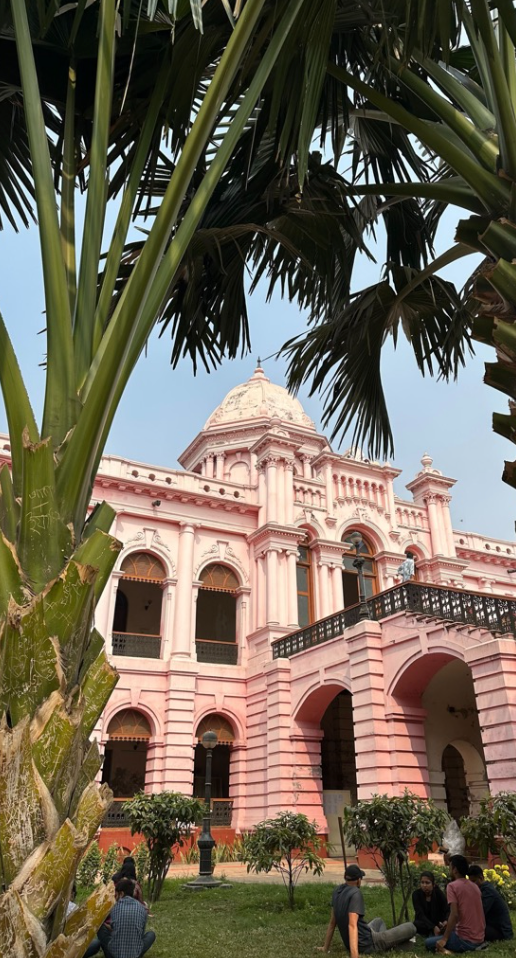
Walking through 17th-century Dhaka, one would see Lalbagh Fort rising on the horizon: a garden-fort where defensive walls met tranquil courtyards, audience halls, mosques, and tombs. Although never fully completed, the fort still speaks of Mughal vision: order, symmetry, and elegance adapted to local materials and the landscape.[4]
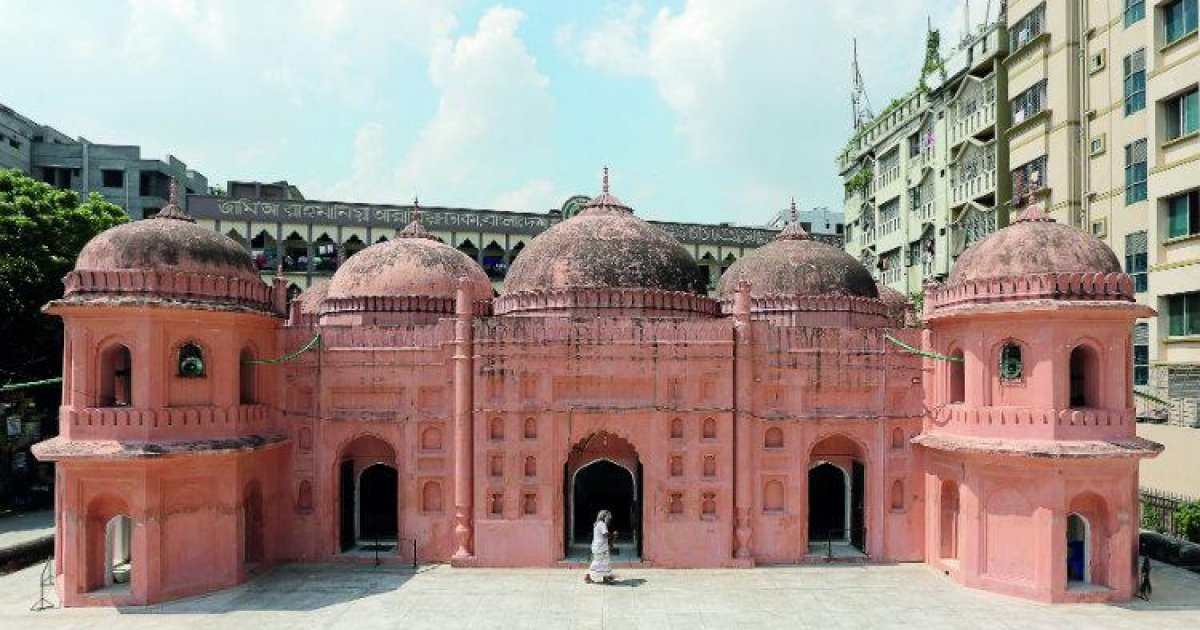
The mosques of the period tell a similar story. Take the Sat Gambuj Mosque, its multiple domes and simple, axial plan may appear restrained at first glance. Still, every curve, every arch reflects a careful balance between Mughal aesthetic ideals and the practical realities of Bengal's climate.[3] In fact, the serial mosques of the region exhibit a recurring architectural language: domed roofs, brick walls, and courtyards designed not only for devotion but also for ventilation, community gathering, and environmental harmony.[2]
Even outside Dhaka, river forts like Hajiganj, Sonakanda, and Idrakpur dot the landscape, standing as silent witnesses to a Mughal strategy of defense and trade protection. Built with local bricks and lime plaster, these forts illustrate a clever fusion: imperial design principles meeting the constraints and opportunities of the delta.[1]
Inscriptions and archaeological evidence in towns like Greater Cumilla reveal that this architectural vocabulary didn't vanish with the decline of Mughal authority. Instead, it continued to influence local builders, blending with regional techniques to shape mosques and civic spaces for generations.[5]
In every dome, wall, and courtyard, the story of Bengal Subah survives. It is a tale of adaptation, elegance, and cultural dialogue of how an empire's vision found a home in Bangladesh's rivers, bricks, and communities.[2]
References
[1] UNESCO World Heritage Centre. (n.d.). Mughal Forts on Fluvial Terrains in Dhaka. Tentative List nomination.
[2] UNESCO World Heritage Centre. (n.d.). Mughal Mosques in Bangladesh. Tentative List documentation.
[3] Shamsuzzoha, A. T. M., & Islam, H. (2011). Structure, Decoration and Materials: Mughal Mosques of Medieval Dhaka. Journal of the Bangladesh Association of Young Researchers.
[4] Rasheed, S., Ibne Iqbal, M. J., & Sharmin, F. (2023). A Walk Through the History and Exploring the Conservation Project of Lalbagh Kella. AJIRI.
[5] Khan, M. M. H., & Ridoy, N. A. (2026). An Unpublished Late Mughal Mosque Inscription: Local History of Greater Cumilla. Journal of the Asiatic Society of Bangladesh, Humanities.