




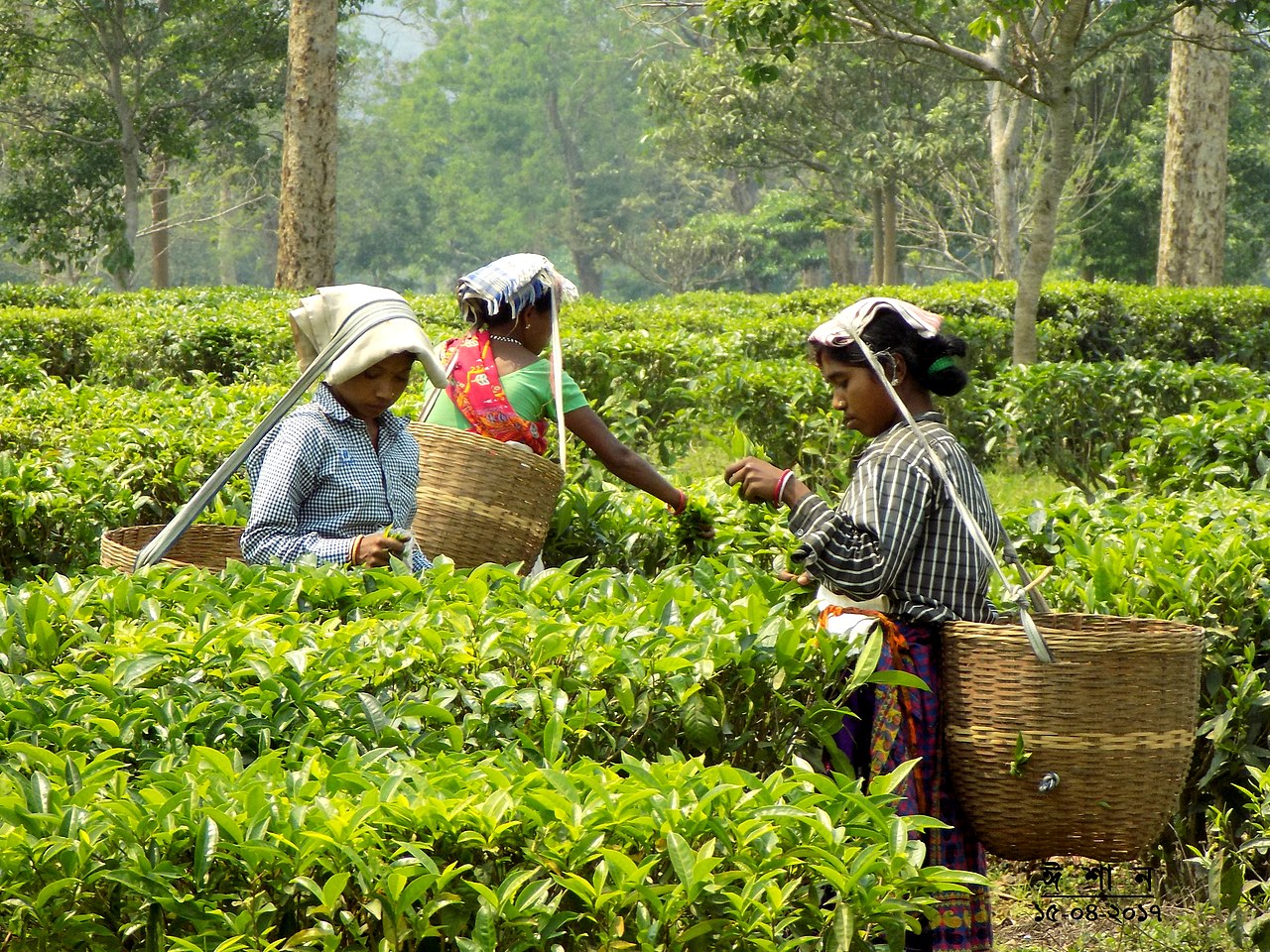
Bangladesh produces nearly 3% of the global tea output, according to the Bangladesh Tea Board, consistently ranking amongst the top 10 global tea producers as of 2025 and exporting to numerous countries, such as Pakistan, the UAE, Russia and the United States.[1] The industry provides over 100,000 people with direct employment in 166 tea estates, providing livelihood to 500,000 people directly and another 500,000 people indirectly through tea trading, brokerage, warehousing and other supporting service industries.[2] Overall, over 4 million people depend on tea cultivation and processing,[3] with the average increasing rate of production over a 5 year period currently standing at 3.97%.[4] Tea is currently cultivated mainly on the flatlands of Panchagarh, Thakurgaon, Dinajpur, Nilphamari, and Lalmonirhat, with the total area under tea cultivation expanding to 10,170.57 acres.[5]
In the tea workforce, women currently make up over 75%, yet their central role in an industry employing around 400,000 workers is met with deep structural neglect.[6] In tea-growing communities, inadequate sanitation, poor reproductive healthcare, sexual abuse, and economic disempowerment combine with poverty and restrictive cultural norms to place women at continuous risk, both inside and beyond the workplace.
Sanitation
For women working in tea farms, sanitation, hygiene and general cleanliness is often overlooked, if not completely ignored due to the lack of fresh water and insufficient toilet facilities. This leaves women unable to cleanse or relieve themselves while working. A survey conducted in 10 tea gardens among 100 female workers found that; 80% of women urinate in the open during working hours, with only 10% using soap for cleaning, with the majority at 70% using sand.[7] This also means that women menstruating are unable to change their menstrual absorbent material on a regular enough basis, which can lead to infections or discomfort. This risk is further exacerbated by the fact that 94% of women use cloth instead of commercial sanitary products while menstruating.[8] A study in the Kodala estate in 2024 found that 98% of female workers find it extremely difficult to work during menstruation, with a further 90% suffering from various health problems due to poor menstrual hygiene practices. These include: genital itching, pain during sexual intercourse and increased white (vaginal) discharge.[9] The issue is worsened through the lack of open communication, education and awareness about female menstrual hygiene in these tea farms. Dr Monzur-A-Moula, a junior consultant at the Maternal and Child Health Hospital, commented that, "social stigma worsens the problem. Menstruation is rarely discussed in tea communities. Women feel ashamed to seek help and are forced to work through pain without clean toilets or rest."[10]
Reproductive Health
Women working in tea farms often hide their cancer diagnosis to avoid facing social stigmatisation, so by the time it reaches an advanced stage, it is too late for effective surgical treatment. This was the case of Ramdulari Kairi, a tea leaf picker at Satgaon Tea Estate in Sreemangal, who died at age 48 of cervical cancer, after she continued to work in the tea garden despite her immense pain. The concealing of symptoms and pain out of shame is also seen in women who suffer from obstetric fistula, vesico-vaginal fistula (VVF) and recto-vaginal fistula (RVF), which causes urinary and fecal leakage, tissue damage and kidney infections, as well as other irritative type symptoms,[11] where the only solution is typically surgery. A 2018 study conducted in 10 tea gardens in Moulvibazar district by the Centre for Injury Prevention and Research (CIPRB) found 20 women were suspected of having fistulas, 5 of which were later confirmed, all of whom were married before the age of 16, falling pregnant the following year.[12] Those who marry at a young age, which is a common practice of girls in tea farming communities, face a higher risk of fistulas because they often give birth before their bodies are fully developed.
Furthermore, pregnant women face their own challenges of miscarriage, stillbirth, and maternal death. Women leaf-pickers often work long hours, walk long distances to reach their workplaces, and remain on their feet throughout the day. Pregnant women frequently continue working until the end of their pregnancies, increasing their health risks. This is due to the fact that many women workers are only able to take maternity leave after childbirth. This was the case of Anika Munda (29), a tea leaf picker of Jagcherra Tea Estate, who delivered a stillborn baby following a 4 hour walk home after picking tea leaves the day before. This had been her sixth pregnancy.[13]
Additionally, the story of Mithila Nayek (22), a tea leaf picker from Hossainabad Tea Garden in Sreemangal, highlights the severe challenges pregnant women face in tea gardens. After three miscarriages, she gave birth on October 6, 2018, at the Sreemangal Health Complex. Soon after delivery, her newborn struggled to breathe and did not cry at birth. With no ambulance available, Mithila and her baby waited outside the health complex for 45 minutes while her family searched for transport. They were eventually taken by CNG to Moulvibazar District Hospital, where the baby survived after receiving care.[14] The case underscores the lack of emergency transportation, poor road conditions, and inadequate maternal healthcare for tea garden workers, forcing mothers to endure dangerous delays during critical moments.
Although women can go to the government hospitals, such as the District Sadar Hospital, upazila health complex, union health and family welfare centres, and community clinics in close proximity to tea gardens, many of them simply don't. This is because tea workers spend at least 8 hours a day working on the farms for 6 days a week, the 7th day usually consisting of household chores, therefore leaving them constrained by time, as well as money.[15]
According to the Department of Health, Moulvibazar district recorded 120 maternal deaths in 2014, 48 of which (39.1%) occurred in tea gardens, despite their relatively small population.[16] This indicates that the health status of female tea workers is poorer than the national average. Furthermore, according to a 2020 report by the Bangladesh Tea Board (BTB), tea garden owners operate 78 hospitals and 162 dispensaries. However, workers report widespread dissatisfaction with these facilities, which lack the capacity to treat critical illnesses such as tuberculosis and cancer. The prenatal and postnatal care provided is also largely inadequate.
Sexual Abuse
Female tea workers often are forced to silently endure sexual harassment, neglect and exploitation in fear of becoming unemployed or bearing the weight of the social stigma that comes with speaking up. A report published by the Bangladesh Institute of Labour Studies (BILS) revealed that approximately 15% of the female workers in 41 tea gardens located in Moulvibazar have fallen victim to sexual assaults within their workplaces, which is the equivalent of 22 workers out of 150.[17] The study also revealed that 69% of victims chose to not make complaints about their harassers, ultimately staying silent. A survey of 41 tea gardens found that about 53% have patras (wine shops), nearly 28% of which operate illegally. Female workers reported sexual harassment by intoxicated male colleagues, alongside physical abuse by supervisors and higher-ranking staff. Despite these findings, officials from the Department of Narcotics Control said they were unaware of illegal patras and promised to investigate.[18] These tea gardens lack the presence of sexual harassment prevention committees, which leaves the female workforce particularly vulnerable. Additionally, 43% of female workers stated that they had also suffered verbal abuse, highlighting the mistreatment that many women face in these tea gardens, despite their critical role in the industry.
Lack of Security and Ownership
Women comprise the majority of the tea gardening workforce, however, these women often don't economically benefit from their hard earned wages. A study in 2014 found that 68% of female tea workers have no control over their own income, with the majority of income going straight to their husbands, leaving the women without decision making power on how their earnings are used.[19] The economic disempowerment is further deepened by the fact that 94% of these women do not own hereditary property despite legal entitlement, hindering financial independence and future security. Furthermore, 92% of female workers reported that they were physically tortured or mentally harassed by husbands, male family members, and estate representatives, demonstrating that systemic economic repression is not limited to just the workplace.[20] Women also face job insecurity without access to legal protection, as 97% of female tea workers do not have formal appointment letters, and 87% have no identity cards,[21] overall enhancing the lack of labour rights and financial autonomy.
Poverty in the Patriarchy
Approximately, 74% of tea garden workers still live below the poverty line in the Sylhet region, having detrimental impacts on social life. Many of the sociocultural practices of tea workers both stem from and perpetuate chronic poverty. Tea plantations are shaped by a culture that prioritises work and income generation rather than formal education, especially for women. This inclination toward wage labor encourages early entry into plantation work, particularly amongst women.[22] Socioeconomic challenges, including household poverty, early marriage, and limited access to educational institutions, remain major barriers to girls' schooling. One worker, Sonali Modi (33) shared her experience in an interview, saying, "I am the eldest of five siblings. Both of my parents worked on the tea plantation, but their combined income was insufficient to support our family. Many days, we ate one full meal and relied on chira (flattened rice) or muri (puffed rice) for the remaining meals. I completed education up to class five and then left school to work on the plantation to help support my family". For women in tea plantation communities, wage labor is often prioritised over formal education and is regarded as a routine part of life. Within backgrounds of chronic poverty, women like Sonali are compelled to choose earning over learning.[23] As a result, girls in tea plantation communities experience both restricted access to education and limited incentives to pursue it.
In other instances of families facing chronic poverty, child marriage is further reinforced, to alleviate the pressure of having an extra mouth to feed in the household. Radha Goala (21), explained, "Tea workers believe daughters are a burden in their fathers' homes, as they cost money but can earn little. People sometimes tell parents, 'You have put a yoke on your shoulders by not marrying your daughter off'. This ultimately would reduce the family expenses, while heavily relying on financial support from their sons."[24]
Cultural Expectations
Tea worker communities are characterised by strong social conservatism. Dominant cultural norms discourage interaction between boys and girls, viewing romantic involvement, or even ordinary social contact, as socially deviant. As a result, early marriage is widely practiced, often justified as a means of safeguarding girls' social reputations and regulating their behavior.[25] This is seen in the story of Beauty Rani (22), who expressed, "Most often, when a girl reaches about 15, people in her vicinity ask her parents, 'Your daughter is advancing in age. Why do you not intend to get her married? What benefits does she stand to gain from education? Once she arrives at her in-laws' home, she will engage in household chores. How does education prepare her for that?'" She continued,[26] "Many people in the garden [plantation] believe that if the girl leaves the garden, she may become involved in a romantic relationship and lose her virginity. They dislike the girls' going out and about. Parents may also think their adult daughters will run away from home with their boyfriends. To maintain family prestige, they marry their daughters off quickly."
A Glimpse of Hope?
However, there have been recent efforts to improve the lives of female tea garden workers and their families in Sylhet Division, most notably, the UN-led Joint Programme,[27] which focuses on empowering women workers, their families, and trade unions to claim their rights to social protection, labour standards, participation, and access to information and development opportunities. The programme strengthens government policies and labour law implementation, improves data collection and service delivery systems, and increases workers' awareness of their rights and available services. It also supports women tea workers to organise, demand accountability, and advocate for full inclusion in Bangladesh's national social protection system, promoting a more coordinated, equitable, and dignified working environment.
The story of Ms. Srimoti Bauri,[28] Vice Chair of the Bangladesh Cha Sramik Union valley committee in Moulvibazar, is a case that recognises that initiatives and programmes such as this one, can exist as a source of hope for tea garden workers and their families. Coming from a family of generational tea garden workers, she has continued the tradition since 2016 and has risen to become one of only three women vice-chairpersons of the union's valley committees. In her role, she represents hundreds of women workers, advocating for women's empowerment, better living and working conditions, and the establishment of women's rights within the marginalised tea garden community of Sylhet.
Despite this specific success story, it is clear that there is still a long way to go to meaningfully dismantle the exploitative structures in the tea gardens - to ultimately allow these women to taste the fruits of their labour. The struggles faced by women in Bangladesh's tea gardens are not isolated hardships but the result of systemic neglect woven into the industry itself. Without urgent action to address health, safety, and rights, the cycle of poverty and exploitation will continue to be passed from one generation to the next.
References
Bibliography
Adhikari, Dr. Manju Lata. “Maternal and Menstrual Health Challenges of Tea Plantation Women in South Asia: A Comparative Study of Assam and Bangladesh.” International Journal for Multidisciplinary Research (IJFMR) 7, no. 5 (September–October 2025). https://doi.org/10.36948/ijfmr.2025.v07i05.57090.
Bangladesh Tea Board. Overview of Bangladesh Tea. n.d. Accessed February 10, 2026. https://www.btabd.com/overview.
Bangladesh Tea Board. Wikipedia. Last modified 2025. https://en.wikipedia.org/wiki/Bangladesh_Tea_Board.
Boonerjee, Shefali, M. Ashraful Islam, S. M. Monwarul Islam, Shovon Kumar Paul, M. T. Uddin, and M. S. Alamgir. “Consumption and Export Potential of Tea in Bangladesh: A Field Study.” Journal of Agriculture and Food Research 19 (March 2025): 101607. https://doi.org/10.1016/j.jafr.2024.101607.
Bogdad, Md. Junaid. Tea Industry of Bangladesh: An Overview of Production and Export Opportunity. Volume 1. November 2022. https://emergingrating.com/wp-content/uploads/2022/11/Tea-Industry-of-Bangladesh_An-Overview-of-Production-and-Export-Opportunity.pdf.
Chowdhury, Nibedita, Md. Abdul Ahad, Mitu Chowdhury, Indrajit Kundu, and Tamanna Islam. “Health and Hygiene Condition of Female Tea Workers: A Study in Three Tea Gardens of Sylhet District.” Asian Journal of Agricultural Extension, Economics & Sociology 26, no. 1 (2018): 1–9. https://doi.org/10.9734/AJAEES/2018/42366.
Gain, Philip. “Why Do Women in Tea Gardens Face Higher Reproductive Health Risks?” The Daily Star, March 7, 2023. https://www.thedailystar.net/opinion/views/lets-talk-about-it/news/why-do-women-tea-gardens-face-higher-reproductive-health-risks-3265511.
Hassan, A. B. M. Enamol. “Deplorable Living Conditions of Female Workers: A Study in a Tea Garden of Bangladesh.” American Journal of Humanities and Social Sciences 2, no. 2 (2014): 121–132. https://doi.org/10.11634/232907811604522.
Hossain, Rabby. “The Tea Industry of Bangladesh: Tradition Meets Global Growth.” Inside Bangladesh, October 12, 2025. https://inside-bangladesh.com/tea-industry-of-bangladesh/.
Islam, Md Nazrul, and Md Al‑Amin. “Poverty and Education: The Impacts of Tea Workers’ Chronic Poverty on Their Children’s Education in Rural Bangladesh.” Labor History 67, no. 1 (2026): 71–87. https://doi.org/10.1080/0023656X.2025.2451414.
Joint SDG Fund. 2025. “Enhancing Social Protection for Female Tea Garden Workers and Their Families in Sylhet Division, Bangladesh.” Joint SDG Fund. Accessed February 12, 2026. https://jointsdgfund.org/programme/enhancing-social-protection-female-tea-garden-workers-and-their-families-sylhet-division.
Joint SDG Fund. “Female Tea Garden Workers: Workplace Sanitation Still a Far Cry for Them.” Joint SDG Fund, December 8, 2021. https://jointsdgfund.org/article/female-tea-garden-workers-workplace-sanitation-still-far-cry-them.
LightCastle Analytics Wing. Overview of the Tea Industry of Bangladesh: Current Challenges and Future Potentials.LightCastle Partners, December 21, 2022. https://lightcastlepartners.com/insights/2022/12/overview-of-the-tea-industry-of-bangladesh-current-challenges-and-future-potentials/.
Paboni, Proma. 2021. “Social Protection for Female Tea Garden Workers and Their Families in the Sylhet Division.” Joint SDG Fund (UN Women), March 8, 2021. https://www.jointsdgfund.org/article/social-protection-female-tea-garden-workers-and-their-families-sylhet-division
Sumi, Saifunnahar. “Plight of Female Tea Garden Workers amid Sexual Abuse.” The Daily Messenger, September 18, 2023. https://www.dailymessenger.net/bangladesh/news/8547.
Tasnim, Tangila. “Bleeding in Silence: Unheard Struggles of Bangladesh’s Women Tea Workers.” The Daily Star, October 30, 2025. https://www.thedailystar.net/news/bangladesh/news/bleeding-silence-unheard-struggles-bangladeshs-women-tea-workers-4023556.
TBS Report. “Female Tea Workers’ Rights Situation Unsatisfactory: Study.” The Business Standard, September 12, 2023. https://www.tbsnews.net/bangladesh/female-tea-workers-rights-situation-unsatisfactory-study-699446.
“Tea Production in Bangladesh.” Wikipedia, The Free Encyclopedia. Last modified January 31, 2026. https://en.wikipedia.org/wiki/Tea_production_in_Bangladesh.
[1] Inside Bangladesh, 2025
[2] Bangladesh Tea Association, 2026
[3] STB Leaf, 2025
[4] Journal of Agriculture and Food Research, 2025
[5] Emerging Credit Rating Ltd, 2022
[6] Md. Abdullah Al Mamun and Apu Gaual, 2025
[7] Joint SDG Fund, 2021
[8] International Journal for Multidisciplinary Research, 2025
[9] International Journal of Research, 2025
[10] The Daily Star, 2025
[11] John Hopkins Medicine
[12] The Daily Star, 2023
[13] ibid
[14] ibid
[15] ibid
[16] ibid
[17] The Daily Messenger, 2023
[18] ibid
[19] M Enamol Hassan, 2014
[20] ibid
[21] The Business Standard, 2026
[22] Md Nazrul Islam and Md Al-Amin, 2026
[23] ibid
[24] ibid
[25] ibid
[26] ibid
[27] Joint SDG Fund, 2025
[28] Joint SDG Fund, 2021