




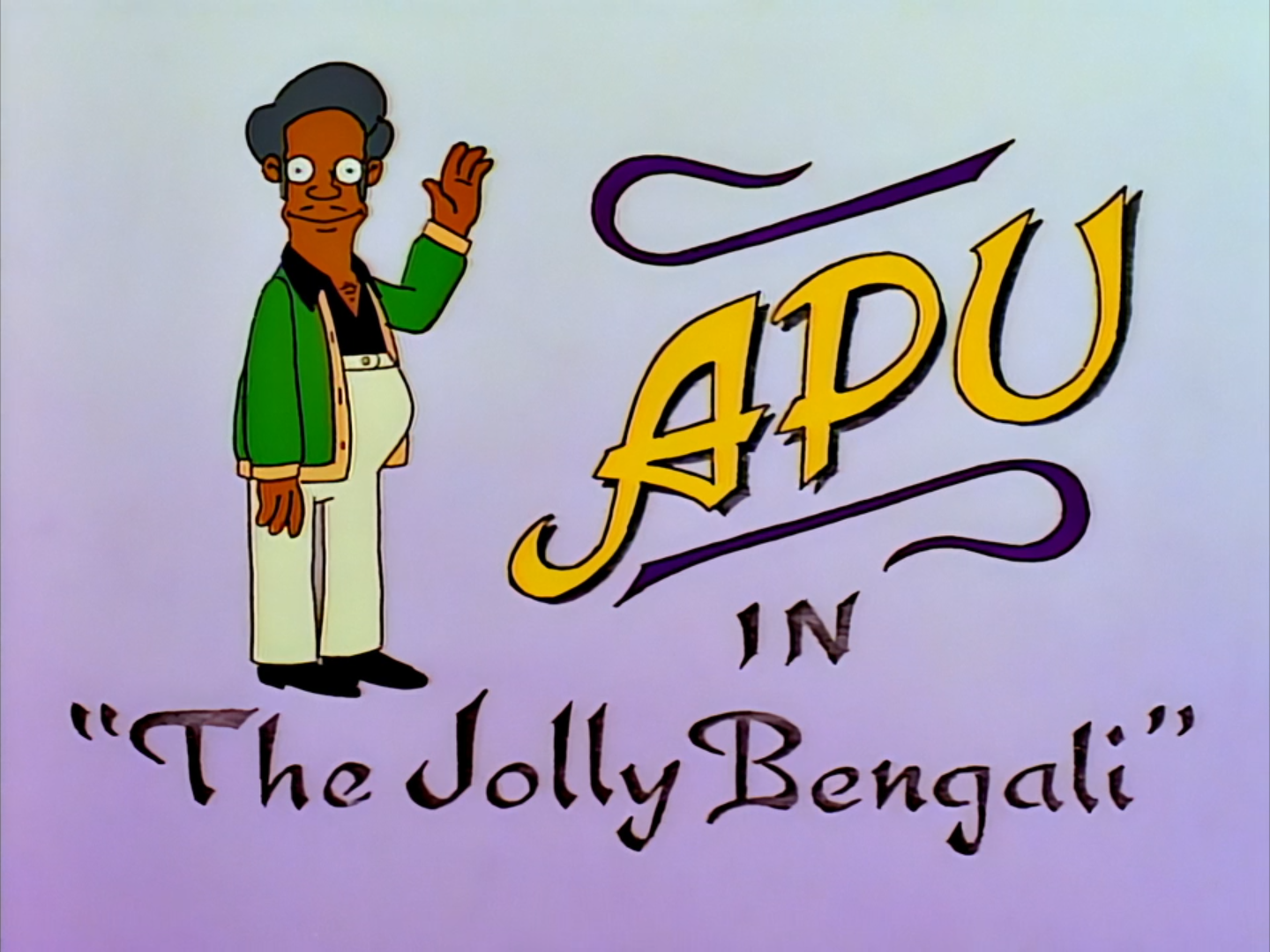
Apu from the Simpsons is technically Bengali-Hindu, but his portrayal as a homogenized Indian is at odds with his origins. As a result he repeats, enables, and affirms the homogenized Indian stereotype, and the popularity of the character has let the homogenized Indian stereotype trickle down into other comedy series, even those aimed at children. This is about whether or not Apu is harmful, and not about whether or not Apu is racist. Additionally, something can be racist and/or harmful, and still be funny.
Production Origins
In the Simpsons, it has been claimed that Apu is Bengali. In Simpsons episode 'Homer and Apu', he claims he is from Rahmatpur, West Bengal, India [1]. The first name Apu is a reference to the titular character in Satyajit Ray's The Apu Trilogy [2]. There is a claim that the Simpsons writers did not originally intend for Apu to be Indian because they were worried it would be too offensive [3]. Hank Azaria, the voice actor for Apu disputed this claim. He stated that the writers immediately asked him to do an Indian accent and asked him how offensive he could make it [4]. Azaria himself is not South Asian. Azaria furthers that he based Apu's voice on various Indian convenience store workers he came into contact with in Los Angeles. He has also maintained that Apu was based on Peter Sellers' character Hrundi V. Bakshi from the 1968 film The Party [5]. The film has been put under retrospective criticism for its use of brownface and exaggerated accent in its portrayal of Indians. Interestingly enough, the film is largely popular in India. Some Peter Sellers' fans include: Indian Prime Minister Indira Gandhi, and Bengali-Hindu director Satyajit Ray.
![[26]](https://i.gyazo.com/0bb6d8e7a9ad49f796128d43fee52323.png)
Issues with Apu's portrayal
Early in the Simpsons release, the writers received criticism for the depiction of Bart as someone who received no punishment for his misbehavior. This led some parents to characterize him as a poor role model for children [6]. Simpsons producer James L. Brooks said in response, "I do think it's important for us that Bart does badly in school. There are students like that. Besides, I'm very wary of television where everybody is supposed to be a role model. You don't run across that many role models in real life. Why should television be full of them?" [7]. The show does not position Bart as a moral template to emulate. Bart's misbehavior is not necessarily celebrated in the show as much as it is used to expose contradictions in school systems and authority figures. The Simpsons is not really about role models, more so about humor. Therefore, Apu was never meant to be representative of all South Asians. Unfortunately, he was the most widely known South Asian on American television in the 1990s-2010s. Thus, he was a lot of people's introduction to Indian culture. This widespread visibility, and later popularity, made the inaccuracies of his portrayal even more prominent, but only noticeable to those who are Indian and/or South Asian. Although it is said in the show that Apu is Bengali, what is clear for Bengalis is that he is not adequately portrayed as one.
In Hari Kondabolu's The Problem with Apu, his main argument is that Apu is a racial caricature with an over exaggerated accent, and his depiction being the most widely known representation of Indians on TV in the 1990s-2010s, it popularized the depiction of Indians with the over exaggerated accent so much so that it was difficult for many South Asian actors to find any roles without doing the over exaggerated accent [8]. Comedian Akaash Singh counters that Apu is the most three-dimensional supporting character on the Simpsons, and he is an example of the American dream [9]. He defends the depiction of the character as he claims that at the time there were little to no South Asian voice actors, it was a situation where Hank Azaria was doing many voices already and they just gave him another, and the Simpsons likely didn't have the budget for extra actors for supporting characters [9]. Singh brings up some valid points, but I would push back on the American dream depiction argument. I would counter that even though Apu is a depiction of the American dream, he is definitely still a bad depiction of the American dream. In the majority of Apu's appearances, he is seen as being unhygienic and scamming his customer base by selling them expired or dirty food. Ultimately, there's no way to dress up these negative traits to align them with any nostalgic memories of Apu. Apu gives South Asians a bad rap.
Stereotypes in Apu's Background
These two traits, being cheap and unhygienic, while being running jokes throughout the series are not the only stereotypical things about Apu's character. Apu had overstayed his student visa, underemployed as a store clerk despite holding a PhD in Computer Science, had an arranged marriage, and had 8 kids. Some stereotypical traits are explained away in canon to be coincidences. His wife just so happened to take large amounts of fertility drugs to produce eight babies at the same time [10]. He just so happened to want to get an arranged marriage, and to work as a store clerk. The latter is an example of underemployment.
Underemployment is defined as overqualified workers who are considered overqualified, or who have education or skills beyond their role's requirements. In the Simpsons episode 'Much Apu About Nothing', it is stated that Apu started working at the Kwik‑E‑Mart to repay the student loans for his PhD, but he loved working there enough to pursue it full time [11]. The main issue of recent immigrants with higher education degrees not being able to find relevant work is that their education is unrecognized due to them having foreign credentials. For example, a doctor educated in India immigrated to the US not being able to find work, having to redo their education due to their foreign credentials, and then seeking clerical work instead. This is a prevalent issue for recent immigrants. This isn't the case for Apu. He got his PhD from the local Springfield Heights Institute of Technology [11], so there are no foreign credential issues and he could get a job that is relevant to his field if he wanted to. While Apu's underemployment is never made fun of, it is also never addressed seriously. Not to mention the issue of Apu's underemployment while he also has high expenses as he has eight children, and it is never made clear whether or not Apu fully paid off his student loans.
Another point to why Apu is an inadequate portrayal of Bengalis. When he, his parents, or his wife Manjula speak their native language they speak Hindi. Interestingly enough, though the language they speak is portrayed as Hindi, they are actually speaking gibberish [10][12]. This is a common trait in the depiction of foreign minority groups in the Simpsons as in the episode 'One Fish, Two Fish, Blowfish, Blue Fish', when Homer visits a Japanese restaurant the Japanese workers, while portrayed as speaking Japanese, are actually speaking gibberish [13]. In the Simpsons episode 'The Two Mrs. Nahasapeemapetilons', when Apu and Manjula get married the wedding contains incorrect Bengali Hindu marriage rituals [12]. Instead of any culturally relevant traditions, Apu walks down the aisle riding an elephant. He also only walks around the sacred fire once, as opposed to the traditional seven times. For a South Asian viewer, Apu often feels devoid of culture. The viewer never gets to see his temple, how he prays, any festivals, holidays, or any gorgeous aspects of Hinduism.
![[11]](https://i.gyazo.com/8123887ab6fc1a0d5af1f33220960361.png)
In the Simpsons episode 'Much Apu About Nothing', while saying goodbye to his parents to immigrate to the U.S. for his PhD program, he apologizes to Manjula for not being able to marry her yet [11]. He at that time was a fully grown adult entering a PhD program, and she was clearly depicted as a toddler. This is a one off joke, and, in later seasons, they age Manjula up to be near the same age as Apu. However, this joke is incredibly distasteful, and hardly talked about in online criticisms of Apu. The punchline is essentially child marriage is normal in India. Obviously, child marriage is a prevalent problem in India, it does happen, but it is a topic that deserves more than a two sentence joke, and the implication that this behaviour is normal and encouraged. It is hard to imagine Apu, a beloved Simpsons character, being a pedophile, and entering a marriage with a child. Especially at a time where this was one of the most popular depictions of Indian culture on mainstream American television.
Apu as a Homogenized Indian Stereotype
The homogenized Indian stereotype is when an Indian character is depicted as an unspecified 'generally Indian' ethnic group. Which often include a depiction of them as an amalgamation of different Indian ethnic groups, instead of any one specific Indian ethnic group. This describes Apu perfectly. His last name Nahasapeemapetilon is a scrambled version of Pahasadee Napetilon. This is claimed to be the name of a classmate of Simpsons writer Jeff Martin [6][14]. Pahasadee Napetilon is not a name of any Indian origin. It is safe to say this is a made up last name that is meant to sound like a South Indian or Tamil name. Apu is supposedly Bengali, speaks Hindi, and has a South Indian or Tamil naming stereotype. Apu is an amalgamation of a Bengali, a North Indian, a South Indian, and a Tamil. This is very clearly a homogenized Indian stereotype as his specific ethnic group or culture is not regularly mentioned, and there are often jokes in the Simpsons that play on the idea that this is just how an 'Indian' acts. Sometimes, right before a 'generally Indian' walks into a scene there plays a sitar riff or some mystical Indian music. This trope is present for Indian characters Ravi Ross from Jessie, Baljeet from Phineas and Ferb, and Apu from the Simpsons. This trope is analogous to the trope of the ringing of a gong preceding the entrance of the East Asian character Long Duk Dong in Sixteen Candles, and other films stereotypically depicting Asian characters.
The Harm in the Homogenized Indian Stereotype
Apu's depiction as a homogenized Indian stereotype is inherently harmful due to it being surface level representation. Though some episodes place his origin as being from Bengal, he is meant to be depicted as 'generally Indian'. This is not only harmful for Bengalis, but for all South Asian ethnic groups. Surface level representation is still representation for South Asians and Indians, but this isolated depiction with largely negative traits shows us that this is representation for everyone and no one at the same time. When this surface-level representation becomes the only widely recognized South Asian character in mainstream American media, it creates a distorted standard for what 'Indian' looks and sounds like. This idea is especially prevalent when considering that Apu is a bad depiction of the culture. He feels devoid of Indian culture, and isn't a good depiction of Indian American culture either. Apu's portrayal ends up flattening entire groups of people into a narrow, negative image. His popularity and humor including the Indian accent has trickled down into other forms of media. Thus, his popularity reinforced the limited range in roles for South Asian actors in the 1990s and early 2000s, and normalized laughing at the Indian accent.
The Homogenized Indian Stereotype in Other Media
This idea of a homogenized Indian stereotype has trickled down into other media. While no character can be definitively linked to Apu without explicit confirmation from their creators, the recurrence of the homogenized Indian stereotype across multiple comedy series is clear. One example would be the character of Ravi Ross from the Disney Channel series Jessie. This character's full name is revealed to be Ravi Gupta Balasubramanian Ross [15]. This name is an amalgamation of North Indian and South Indian names. Gupta is North Indian and Balasubramanian is South Indian. It is also mentioned that he was born in Kolkata, but he speaks only Hindi. It is entirely possible he learned Hindi in Kolkata, but to not learn Bengali is strange. These are examples of him being an amalgamation of different Indian ethnic groups. Additionally, most of the show talks about him being Indian or from India instead of him being from one specific Indian ethnic group. The naming choices of Ravi from Jessie are reminiscent of Apu's made up last name. These beg the question, are made up names inherently racist or harmful? Is naming characters names that no Indian would have inherently racist? Hasan Minhaj's standup special 'Homecoming King' has a joke about a girl who broke up with him for being Indian who later on married a man with a comedically more Indian sounding name, Rajesh Rengatramanajananam. [16]. Obviously, Rengatramanajananam is a made up last name. Is this inherently racist or inherently harmful? South Asians like this joke. Many South Asians were laughing during this joke in his stand up special. It's a funny joke, but it's kind of like poking fun at made up Asian-sounding names like Apu Nahasapeemapeliton, and Long Duk Dong. Is it better because Hasan Minhaj is Indian, and thus, poking fun at his own culture? Obviously, the joke is completely fine, but is it even him poking fun of his own culture if the joke is about a South Indian naming stereotype?
In contrast, Baljeet Tijinder from Phineas and Ferb has a normal Punjabi name. Though, it is never mentioned in universe if he is Punjabi. Baljeet is a sweet, albeit stereotypical depiction of a young Indian boy. Though Baljeet also enables the model minority myth as he is portrayed as extremely fixated on having excellent grades, there are multiple jokes where he is seen as unattractive or undesirable, and there are some inaccuracies in his depiction. As he stores curry powder in the fridge, and puts curry powder in gelatin.[17][18] Though stereotypical, Baljeet shows a tremendous improvement in the depiction of South Asians when held in contrast with Apu.
The Simpsons Response to The Problem with Apu
In response to Hari Kondabolu's documentary The Problem with Apu, Hank Azaria announced that he and the production crew of the series had agreed for him to step down as the voice of Apu. He has since appeared only as a background character with little to no visibility.
In the podcast Pablo Torre Finds Out, Hank Azaria further explains,
"We all just froze at the Simpsons. Does Hollywood have a tradition of doing this in one way or another? Am I part of that? It's a question I still get asked by people. People will say comments on- like still to this day why can you Luigi and Cletus and that's not a problem. But you can't do Apu? Honestly, at first I thought let me look into this and then I'll go back to doing the voice and say I understand, but I'm going to keep doing this. And I was surprised myself that I came down on no, actually I think I am participating in a harm here. I did a movie once with a very talented vocal guy. And he would do sort of a Jewish voice. Didn't bother me at all as a Jewish person that he would do this voice. But then I started thinking, well what if this voice was the only character in American pop culture for 20 years for Jews. And people just assume- Hey! You talk like this- your father talks like this? Because I probably wouldn't love that. However, even if that were the case, which it isn't, I am a white guy. So when I walk around outside unless I talk like this people wouldn't assume that I talked this way, but Hari, no matter how American he is or sounds, appears Indian, and will get Apu crap if somebody decides to give it to him." [19].
These statements illustrate that Hank Azaria has a phenomenal understanding of the situation, and I applaud him for his candor and willingness to interrogate his own complicity in racial stereotyping. Yet this level of self-awareness appears far less evident in the work of Matt Groening and other Simpsons writers. As in the episode 'Attack of the Killer App' in Matt Groening's other hit series Futurama, where after purchasing a parody of the iPhone, the characters visit a garbage planet called the Third World of the Antares System where they find blue humanoid aliens burning e-waste, and using child labour. All of which sport the exaggerated Indian accent [20]. Prior to their entry there was mystical Indian music played, thus enabling the mystical Indian music trope. The aliens and their children were voiced by non-South Asian actors Lauren Tom, and Phil LaMarr [21]. This episode came out in 2010 so a debate on whether or not the writers should have known not to depict aliens from a garbage as Indian accented is to be had. Though there are also episodes where Leela's former boss, an exaggerated Indian accented South Asian man, is voiced by non-South Asian actor Billy West [22]. Taken together, these portrayals suggest that even years after Apu's initial depiction, Groening's creative teams continued to rely on reductive ethnic stereotyping for humor, revealing a persistent blind spot in how South Asian identities are portrayed.
Many view the choice to eliminate Apu entirely from the show as a step in the wrong direction. Comedian Jusmeet Raina, more commonly known as JusReign, jokingly laments about the situation by saying Azaria should come back to voice Apu on the Simpsons, but have to go through a 12 week program where he sits down with an Indian uncle to learn the accent properly [23]. I agree that eliminating Apu from the show entirely was a step in the wrong direction and that had Apu been given a South Asian voice actor, and a well-researched storyline outside of the Kwik-E-Mart that felt like a South Asian experience for South Asian viewers, that would have been more than enough.
Positive Side of Apu and the Downside of Rajesh Koothroppali
This isn't to say there aren't good things to say about Apu Nahasapeemapetilon. He is intelligent, polite, a firefighter, a ladies man, a good friend, and a family man. And he is hilarious. I enjoy watching him way more than I enjoy Rajesh Koothroppali from the Big Bang Theory. Some of Apu's jokes include sarcasm and those that don't involve mentioning his race. While Raj's jokes are more mean spirited and at his expense. Raj follows the Big Bang Theory baseline of jokes involving science and comic books, but those more specific to his character are about how he is Indian, his sexuality, his perceived unattractiveness, and his inability to talk to women. Though Rajesh does not follow the convention of a sitar riff or some mystical Indian music being played as he arrives, in some scenes when Rajesh walks into a group setting the group starts talking about Indian cultural topics unprompted, like Mahatma Gandhi, Indira Gandhi, etc. Though not overtly racist this definitely classifies as a microaggression. The Big Bang Theory feels like they are punching down at Raj while the Simpsons let Apu act as a straight man trope to point out everyone else's ridiculousness. To be clear, I don't like the portrayal of either of these characters. I still cringe when Apu says 'Oh Calcutta!' or calls Manjula 'curryface' and 'chutney butt' in the episode 'Eight Misbehavin' [10], but he still functions as a more well rounded, and self-assured character than Raj, who is too often written as the butt of the joke rather than a participant in it.
The Future of South Asian Representation
For the most part South Asian representation in American/UK television seems to be on an upwards trajectory with lead roles in contemporary comedies like Delhi Boys, Ms. Marvel, New Girl, We Are Lady Parts, Parks and Recreation, Community, The Office (US), The Good Place, and countless others. In 2019, actor Nik Dodani co-founded The Salon along with Bash Naran and Vinny Chhibber. [24] The Salon is a forum for South Asian creatives in western film and television industry that provide mentorship opportunities and provide a list of the best unproduced film & TV scripts from South Asian writers, named the Desi List. [25] Overall, these developments signal a growing shift toward more authentic, empowered, and self-determined South Asian representation in mainstream Western media.
References
[1] The Simpsons, "Homer and Apu," season 5, episode 13, directed by M. Kirkland, written by G. Daniels, Fox, aired Feb. 10, 1994.
[2] J. Rhodes, "Flash! 24 Simpsons Stars Reveal Themselves," TV Guide, Oct. 21, 2000.
[3] M. Reiss and M. Klickstein, Springfield Confidential: Jokes, Secrets, and Outright Lies from a Lifetime Writing for the Simpsons. New York City, NY, USA: Dey Street Books, 2018, p. 107.
[4] paltalkscene, "Apu from The Simpsons on Paltalk and DailyComedy," YouTube, Dec. 6, 2007.
[5] H. Azaria, "Fresh Air," interview by T. Gross, National Public Radio, WHYY-FM, Philadelphia, Dec. 6, 2004.
[6] C. Turner, Planet Simpson: How a Cartoon Masterpiece Documented an Era and Defined a Generation, 1st ed. Toronto, ON, Canada: Random House Canada, 2004.
[7] T. Shales, "The Simpsons—They're scrapping again—but this time it's a ratings fight," The Washington Post, Oct. 11, 1990.
[8] H. Kondabolu, The Problem with Apu Documentary film. truTV, 2017.
[9] J. Rogan, "The Joe Rogan Experience #1773 – Akash Singh," YouTube, podcast video, Feb. 3, 2022.
[10] The Simpsons, "Eight Misbehavin'," season 11, episode 7, directed by S. Dean Moore, written by M. Selman, Fox, aired Nov. 21, 1999.
[11] The Simpsons, "Much Apu About Nothing," season 7, episode 23, directed by S. Dietter, written by D. S. Cohen, Fox, aired May 5, 1996.
[12] The Simpsons, "The Two Mrs. Nahasapeemapetilons," season 9, episode 7, directed by S. Dean Moore, written by R. Appel, Fox, aired Nov. 13, 1997.
[13] The Simpsons, "One Fish, Two Fish, Blowfish, Blue Fish," season 2, episode 11, directed by W. Archer, written by N. Scovell, Fox, aired Jan. 24, 1991.
[14] J. Martin, The Simpsons (Season 4), DVD commentary for "A Streetcar Named Marge." 20th Century Fox, 2004.
[15] Jessie, "Ride to Riches," season 3, episode 25, directed by Bob Koherr, written by Leigha Barr & Pete Szillagyl, Disney Channel, aired July 25, 2014.
[16] Hasan Minhaj: Homecoming King, stand-up special, directed by C. Storer, Netflix, released May 23, 2017.
[17] Phineas and Ferb, "The Fast and the Phineas," season 1, episode 6, directed by D. Povenmire and J. Flynn, Disney Channel, aired Feb. 1, 2008.
[18] Phineas and Ferb: Summer Belongs to You!, directed by D. Povenmire and J. Flynn, Disney Channel, aired Aug. 2, 2010.
[19] P. Torre, "Hank Azaria on His Bruce Springsteen Tribute Band, Apu and Finding His True Voice | PTFO," YouTube, video, 2025.
[20] Futurama, "Attack of the Killer App," season 6, episode 3, directed by S. Sandoval, written by P. M. Verrone, Comedy Central, aired July 11, 2010.
[21] Futurama, "Full Cast & Crew," IMDb.
[22] Futurama, "Full cast & crew," IMDb.
[23] JusReign, "Bring Back Apu," YouTube, video, Dec. 19, 2018.
[24] D.-K. Bhavani, "Nik Dodani, Sujata Day, Kiran Deol on the evolving space for Indian-origin creatives in western cinema," The Hindu, Sep. 24, 2021.
[25] "The Salon, Community, Creativity, Industry," The Salon.
[26] The Simpsons, "22 Short Films About Springfield," season 7, episode 21, directed by Jim Reardon, written by M. Groening et al., Fox, aired Apr. 14, 1996.