



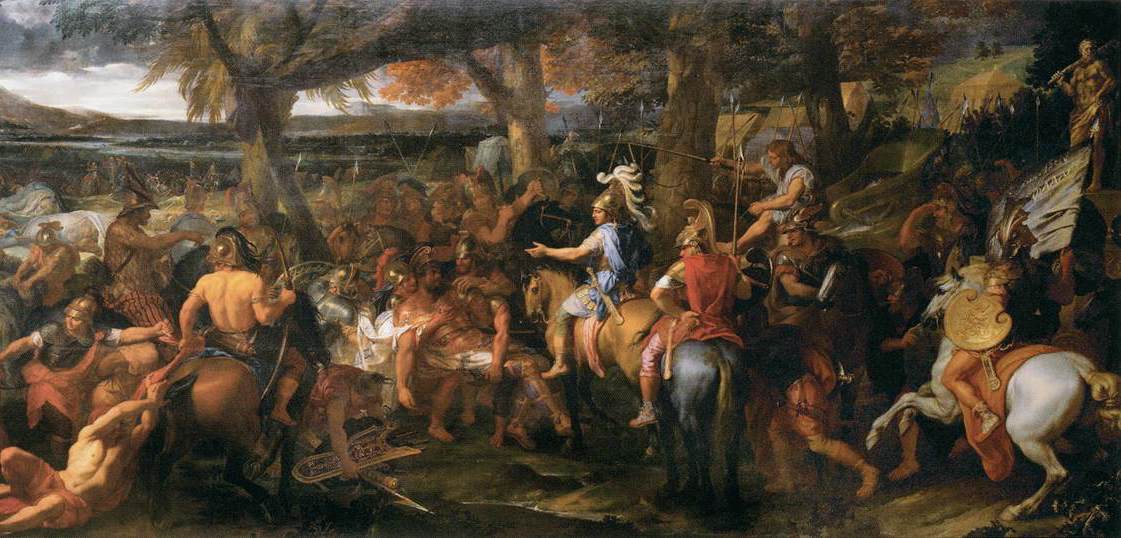
Born in Pella, the capital of Macedonia, in 356 BCE, Alexander the Great inherited Macedonia when his father was assassinated. By age 25, he was king of Macedonia, had reasserted Macedonian power within Greece, and was Pharaoh of Egypt and ‘great king’ of Persia. Before his death in 323 BCE, Alexander established an empire that spanned two million square miles.[1]
Alexander successfully conquered the Achaemenid region, which lay to the west of the Indus River. Diodorus Siculus writes about Alexander the Great’s decision to halt his eastward expansion in his Bibliotheca Historica:
‘He questioned Phegeus about the country beyond the Indus River, and learned that there was a desert to traverse for twelve days, and then the river called Ganges, which was thirty-two furlongs in width and the deepest of all the Indian rivers. Beyond this in turn dwelt the peoples of the Tabraesians and the Gandaridae, whose king was Xandrames. He had twenty thousand cavalry, two hundred thousand infantry, two thousand chariots, and four thousand elephants equipped for war.’
From this account, as well as similar reports from Plutarch (Alexander 62.1), it has often been extrapolated that Alexander turned around due to fear of the Gandaridai and their king.[2] Curtius, Plutarch, Diodorus and Solinus agree in placing the Gangaridai on the eastern bank of the Ganges, in modern-day Bengal, although Greek and Latin historians disagree on the exact boundaries. It can also been inferred that, at the time of Alexander’s invasion of India, the Gangaridai were a formidable nation.[3]
However, classical sources reveal two other key reasons for Alexander’s decision to turn around before he reached the Gangaridai. The first is that the Macedonians suffered insurmountable losses during the battle of the Hydaspes, and therefore mutinied against Alexander until he allowed them to return home. Diodorus Siculus writes:
‘Alexander observed that his soldiers were exhausted with their constant campaigns. They had spent almost eight years among toils and dangers, and it was necessary to raise their spirits by an effective appeal if they were to undertake the expedition against the Gandaridae. There had been many losses among the soldiers, and no relief from fighting was in sight. The hooves of the horses had been worn thin by steady marching. The arms and armour were wearing out, and Greek clothing was quite gone. They had to clothe themselves in foreign materials, recutting the garments of the Indians. This was the season also, as luck would have it, of the heavy rains. These had been going on for seventy days, to the accompaniment of continuous thunder and lightning.’
Between heavy losses, relentless campaigns, and the monsoon season, the Macedonians’ morale was waning, and it is likely that news of preparations by the Gangaridai served as a final straw. Alexander was unable to lift the spirits of his men.[4] When the sacrifices offered before crossing the Hyphasis were unfavourable, he finally agreed to turn back, but not before erecting twelve altars as thanks to the gods and memorials to his conquests.
The second factor reported by Diodorus Siculus is that the Macedonians were deterred by the idea of crossing the Ganges, which was known to be both wide and deep. However, it is crucial to note that the Macedonian party never reached the Ganges (although one member of the party did write home to report that they did).[5] Rather, they halted at the bank of the River Hyphasis, in the Punjab region, heard news of the vastness of the river Ganges, and ended their journey before crossing the River Hyphasis.[6]
Alexander and his men travelled down the eastern boundary of their newly built empire. On reaching the Agalasseis (located in the Punjab region of modern-day Pakistan), who met Alexander’s army with 40,000 infantry and 3,000 cavalry, Alexander massacred and enslaved the entire population. Such massacres were superfluous, including Alexander’s choice to venture hundreds of miles out of his way to attack the Malli.[7] It was during this attack that Alexander’s lung was punctured by an arrow, an injury he initially recovered from, but that presumably contributed to his premature death. Modern historians surmise that Alexander had, by this point, developed sizable megalomania, and therefore responded with extreme brutality when met with armies rather than gifts and submission. While it could be argued that Alexander set out to conquer India in the name of discovery, by this time, it is apparent that Alexander’s expansionism was more centred on his desire to ‘rule the world’.
Although Alexander was in India for less than two years, classical sources gave his time in India a lot of attention. Stoneman theorises that the sources’ focus on India is due to the new and unfamiliar nature of the Indian subcontinent.[8] Since the authors had little knowledge of the region’s geography, ancient sources on Alexander’s time in India contradict themselves as well as each other, making it hard to pass definitive judgments on what took place.
References
Diodorus Siculus, Bibliotheca Historica, Book 17.93, 1st century BCE
Majumdar, R; History of Bengal Volume 1 (1943)
Stoneman, Richard; Alexander and India (Part I – Alexander’s Life and Career, Edited by Daniel Ogden, 2024)
https://www.thecollector.com/alexander-the-great-india-conquest-achaemenid-empire/
https://www.bbc.co.uk/history/historic_figures/alexander_the_great.shtml
[1] https://www.bbc.co.uk/history/historic_figures/alexander_the_great.shtml
[2] Gangaridai can be translated to ‘the people of the Ganges region’
[3] Majumdar (1943)
[4] Stoneman (2024)
[5] Ibid
[6] Majumdar (1943)
[7] Stoneman (2024)
[8] Ibid